

(VAN) After export turnover surpassed USD 1 billion, Viet Nam’s coconut industry faces a new growth opportunity as global demand rises and multiple technical barriers are removed.
Time to “bear fruit”
Mr. Nguyen Dinh Tung, CEO of Vina T&T Group and Vice Chairman of the Viet Nam Fruit and Vegetables Association, said 2026 could mark the time for Viet Nam’s coconut industry to “bear fruit” after years of preparation in export protocols, growing area codes, and quality standards.
According to Mr. Tung, Viet Nam’s coconut industry has steadily affirmed its position in the international market in recent years. After export turnover of coconuts and coconut products exceeded USD 1 billion in the 2024–2025 period, the industry still holds significant room for further growth.
One of the key drivers of the global coconut market is the shift in consumption trends. Consumers are increasingly prioritizing plant-based, environmentally friendly, and health-beneficial products.
In this context, coconut-derived products are increasingly used in the food and beverage industry. Coconut water is no longer just a refreshing drink but is also regarded as a natural electrolyte beverage, aligning with the healthy lifestyle trend.
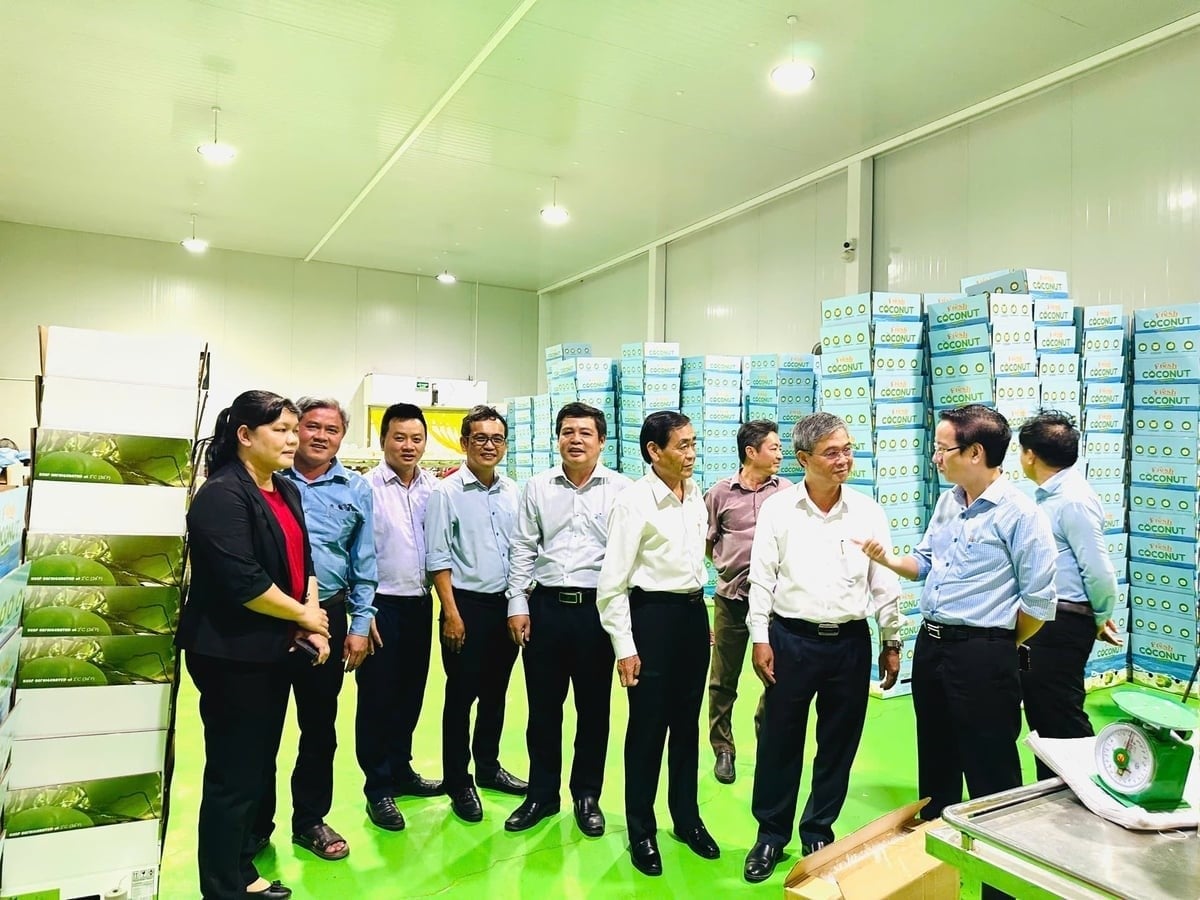
Mr. Chau Van Hoa (third from right), Vice Chairman of the Vinh Long Provincial People’s Committee, visits Vina T&T Group’s fresh coconut processing plant for export. Photo: Minh Dam.
In addition, coconut oil, coconut milk, and various other coconut products are widely used in the vegan food, cosmetics, and healthcare sectors. This trend is opening up enormous growth potential for the coconut industry in many countries, including Viet Nam. Currently, Viet Nam’s coconut products are exported to numerous markets worldwide, spanning Asia, Europe, North America, and the Middle East.
According to Mr. Nguyen Dinh Tung, market opportunities are expanding across multiple regions globally. China remains a major consumption market for Vietnamese fresh coconuts. The shift to official export has helped stabilize trade activities while reducing transaction risks.
Beyond China, the U.S. and the EU are also showing rising demand for coconut products, particularly deeply processed items such as canned coconut water, desiccated coconut, and organic coconut products.
“The U.S. is currently one of the largest markets for Viet Nam’s fresh coconuts. Many importers assess Vietnamese coconuts to have a naturally mild sweetness, distinctive aroma, and strong appeal to consumer tastes,” Mr. Tung said.
In addition to traditional markets, regions such as the Middle East and Japan are also opening up big opportunities for Viet Nam’s coconut industry. Although these markets impose stringent quality standards, they are willing to pay high prices for products that meet their requirements.
According to Mr. Nguyen Dinh Tung, Vietnamese coconuts have distinct competitive advantages over those of major coconut-producing countries such as the Philippines and Thailand. First is the unique flavor of the Siamese coconut variety. In key growing areas such as Vinh Long and Dong Thap, coconuts are known for their naturally mild sweetness and fragrant aroma, qualities that are highly favored in many markets.
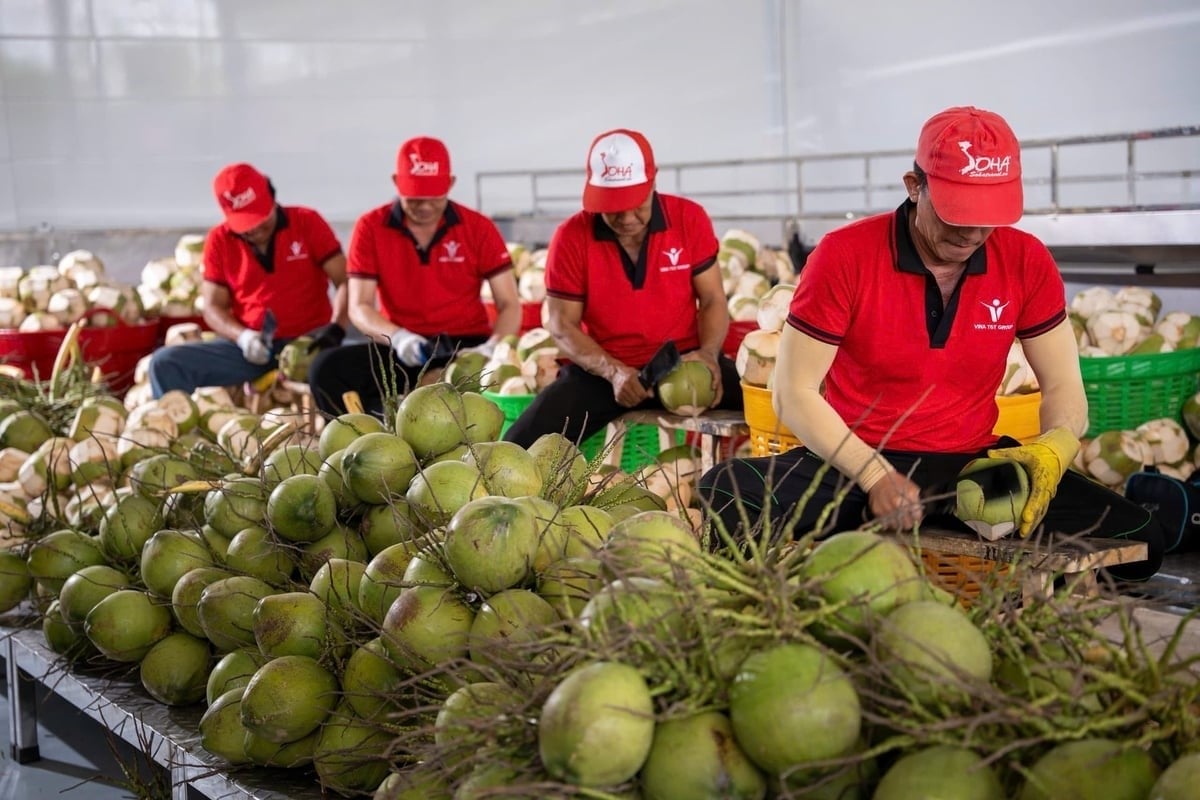
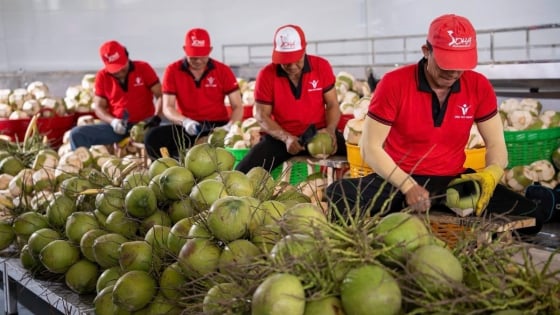
Pre-processing fresh coconuts for export. Photo: Minh Dam.
In addition, Viet Nam’s coconut supply remains relatively stable year-round, with fewer impacts from seasonal fluctuations or natural disasters than in some other producing countries. This allows enterprises to be more proactive in supply plans.
Another advantage lies in the rapid adaptability of Vietnamese businesses in meeting international standards. In recent years, many growing areas and enterprises have obtained certifications such as GlobalGAP, Organic, and ISO to participate in global supply chains.
“Viet Nam’s coconut industry is facing breakthrough opportunities. To achieve this, closer linkages between farmers and enterprises are needed through clean and sustainable value chains,” Mr. Tung emphasized.
Towards USD 2 billion export
Mr. Cao Ba Dang Khoa, Vice Chairman and Secretary General of the Viet Nam Coconut Association, stated that over the past decade, Viet Nam’s coconut sector has recorded significant progress in both production scale and export value. In 2010, the country had around 140,000 hectares of coconut cultivation with export turnover of approximately USD 180 million. By 2025, the area had expanded to over 200,000 hectares, while export turnover surpassed USD 1.1 billion.
In terms of area under cultivation, Viet Nam ranks sixth in Asia and seventh globally. Regarding the branding of value-added coconut products, Vietnam ranks fifth in Asia. Considering overall factors such as cultivation area, output, export turnover, land-use efficiency, and value addition from coconuts, Vietnam ranks second in Asia and fourth worldwide.
Overall, Viet Nam’s coconut sector currently ranks fourth in Asia and fifth globally, behind Indonesia, the Philippines, India, Malaysia, and Brazil. “These figures indicate that coconuts are gradually becoming a key agricultural commodity in Viet Nam’s export structure,” Mr. Khoa said.

Mr. Cao Ba Dang Khoa, Vice Chairman of the Viet Nam Coconut Association. Photo: Minh Dam.
Alongside the expansion of cultivation areas, the network of enterprises participating in the coconut value chain has also grown rapidly. Viet Nam currently has around 600 companies engaged in the production and trading of coconut products.
One of the key drivers behind the sector’s growth in recent years has been the expansion of deep processing. While the country had only about eight coconut processing plants in 2015, the number had risen to approximately 75 by 2025. Many enterprises have invested in modern lines to produce high value-added products such as canned coconut water, refined coconut oil, coconut milk, activated carbon from coconut shells, and coconut-based cosmetics.
According to Mr. Cao Ba Dang Khoa, the development of deep processing has significantly enhanced the value of coconuts while expanding export markets for a range of new products.
“During the 2014–2016 period, only two to three Vietnamese coconut enterprises participated in each international trade fair. At that time, the association even had to proactively collect product samples and catalogs from businesses to showcase at such events. Today, more than 10 enterprises regularly attend international trade fairs, with increasingly diverse product portfolios and improved quality.
This enables the Viet Nam Coconut Association to take a more proactive role in connecting and working with industry associations and major global corporations, thereby expanding cooperation opportunities and market access for Vietnamese coconut products,” Mr. Khoa said.
Amid the growing trend toward green economy and sustainable consumption, coconut is considered a crop with strong potential to participate in circular economy value chains.
Coconut gardens have a relatively high capacity to absorb CO₂, opening up opportunities to participate in the carbon credit market in the future. In addition, many coconut by-products such as husks, coir, and shells can be utilized to produce environmentally friendly products.
According to the Viet Nam Coconut Association, with continued investment in raw material areas, processing technology, and green production, Viet Nam’s coconut industry could fully raise its export turnover to USD 1.5-2 billion in the coming years.
$ 1 = VND 26,112 – Source: Vietcombank.
Agriculture News | Agri Products Price