



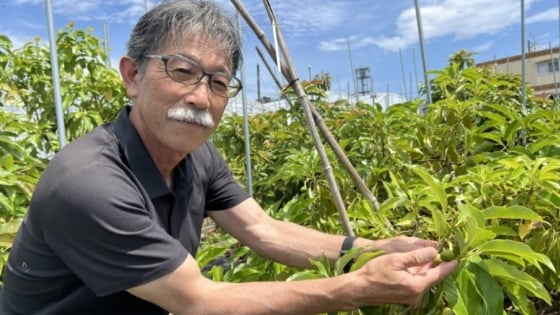
(VAN) Tsutomu Uchida, 64, wipes the sweat from his face as he walks through a farming plot filled with avocado trees in a port district of Shizuoka.
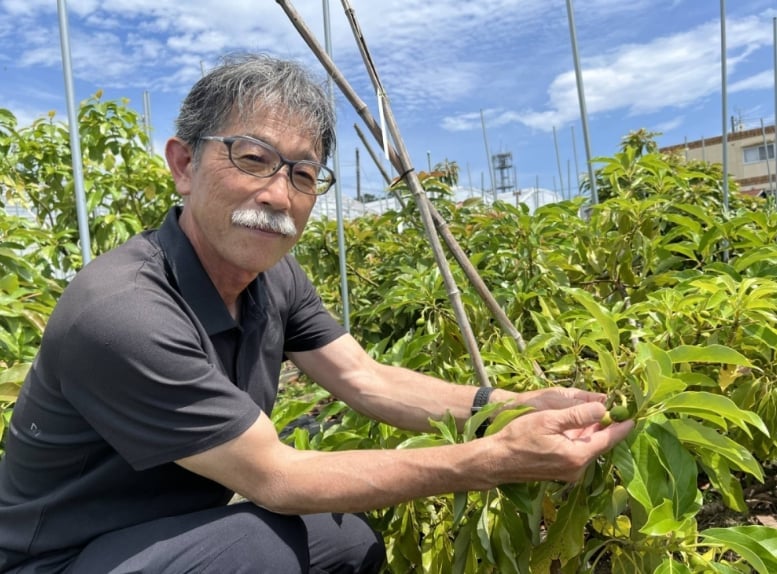
Tsutomu Uchida has experimented with various cultivation techniques since he started growing avocados in Shizuoka Prefecture in October 2020. | TOMOKO OTAKE.
“This kid, right here, is Mexicola, which can be harvested earlier (than other varieties), around September,” Uchida says, affectionately pointing to one of the 19 varieties of avocado he grows there. Most trees are less than 2 meters tall.
“Avocado trees are usually much taller, like 5 meters, if you let them grow. I’ve cut the tops off the trees, so harvesting is easier.”
The retired businessman with three adult sons has experimented with various cultivation techniques since October 2020, when he started renting this 420 square-meter plot of abandoned farmland formerly used to grow melons and flowers. He hopes to discover which variety of avocado — which is almost exclusively imported in Japan — is suitable for the area’s climate.
Rising temperatures are putting a severe strain on Japan’s crop production, as evidenced by the ongoing rice crisis, for which climate change is a contributing factor.
But a growing number of farmers in Shizuoka, traditionally a stronghold of mikan production, are turning their attention to avocados, with recent research showing that, due to human-induced climate change, areas fit for the cultivation of the fruit could dramatically expand across Japan.
A staple of Mexican cuisine has thus emerged as an unlikely symbol of hope for Japan’s agriculture sector, which is grappling with warming alongside an aging workforce and flattening profitability.
“We can’t move forward by just complaining about the negative impact (of the changing farming environment),” says Yuji Hirano, an official in charge of agricultural strategies at the Shizuoka Prefectural Government. “We are trying to turn this adversity into an opportunity and make the best of it.”
Avocado roots
In April, Shizuoka, the nation’s No. 3 mikan producer after Wakayama and Ehime, launched a project to help farmers in the prefecture start avocado cultivation, with the goal of making it its new specialty product in the future. For the current fiscal year through next March, the prefecture allocated ¥18 million toward the research and development of avocado cultivation techniques, which are not well established in Japan. It hopes to publish manuals for farmers in three years.
But why avocados? Hirano explains that, of about 10 subtropical plants the prefecture considered for a production boost, it found avocados to be the most promising because of explosive growth in demand in recent years.
According to customs data, the amount of avocados imported nationwide grew to nearly 80,000 tons in 2020, from around 3,400 tons in 1988. In the 2000s, the media began to label the fruit as a “superfood” and “the butter of the forest,” due to its vitamin- and fiber-rich content. Now, avocados are fully integrated in the Japanese diet, from sushi to salads to sandwiches, and are easily found at supermarkets nationwide. About 85% of the imports come from Mexico and 11% from Peru, according to 2020 trade statistics.
Hirano adds that the prefecture is also banking on its unique historical connections to the fruit. Records show the U.S. Department of Agriculture brought avocado plants to a horticulture research center in the city of Shizuoka as early as 1915, making it the first cultivation site in Japan. But the plant didn’t survive a cold snap that hit the city.
Today, a few regions in Japan produce avocados, though on a small scale. According to farm ministry data, 34 tons were produced in 2022, mostly in Saga, Ehime and Wakayama — all traditional mikan strongholds.
Domestic avocados fetch far higher prices than imported ones, often costing thousands of yen apiece. Farmers feel there may be a market for “premium avocados” among gourmet lovers and high-end restaurants, and see them as a lucrative alternative to mikan, a common fruit with low profitability.
A forum on avocado farming held last month in Shizuoka Prefecture attracted 120 participants, Hirano says, adding that many people were extremely enthusiastic about the potential for avocado crops and eager to learn more about growing them.
Kazuhiro Matsumoto, a professor of horticulture at Shizuoka University who has studied avocado farming for years, gave a lecture at the forum and was also impressed with the enthusiasm shown by those in attendance.
“Some people were excited simply by the money-making potential,” Matsumoto says. “Others were pained by the fact that the farmlands that they had inherited were left abandoned and wanted to do something about it. There were also some young people who were interested in starting farming from scratch.”
Matsumoto cautioned that avocados are far from being easy money, however.
“Growing (avocados) is technically very challenging, and you need to have the perseverance to withstand many setbacks,” he said.
For example, most of the imported avocados currently on the market are of the oval-shaped Haas variety, which is too susceptible to the cold for Japan’s climate. Of the 600 known varieties of avocados, about 20 have been brought to Japan as genetic resources and can be legally grown here, Matsumoto says, noting that farmers in each region need to pick the variety that is best suited for the local climate. The biggest challenge is to find ways for the plants to survive the coldest days of the year.
Even as the climate warms, Japan is still susceptible to the occasional cold snap in the winter.
“If you experience just one day recording minus 6 degrees Celsius, the entire crop could be ruined,” Matsumoto says.
Mikan farmers switching to avocados will also face a financial risk, says Toshihiko Sugiura, who has studied adaptation strategies at the National Agriculture and Food Research Organization.
“It normally takes about five or six years before the first avocado harvest, which means the farmers will lose means of income during the transition.”
Matsumoto says that, since Shizuoka farmers are already producing a wide variety of crops, they should try to maintain diversity and explore sustainable ways to farm. Shizuoka’s proximity to Tokyo works to their advantage, too, he says.
“Beyond selling just avocados, Shizuoka should try to market avocado farming and build deeper relationships with consumers, inviting people to come to the prefecture to grow them together and developing green tourism or new food products,” he says.
Mikan crisis
Meanwhile, mikan, which boasts the largest cultivation area among Japan’s fruit crops, is increasingly challenged by the warming climate.
Mikan flowers today bloom earlier than before, but it takes more time for the fruit to mature, as carotenoid pigments, which produce its signature color, do not accumulate until temperatures drop, says Sugiura.
Because of this, the fruit’s peel tends to age, which causes the pith (the white layer inside citrus fruits) to separate more easily from the peel. Essentially, this means the harvested fruit can get easily damaged during transportation, hurting the farmers’ bottom lines, Sugiura says.
Unlike rice, which can be grown nationwide, fruit trees have lower climate adaptability, and their production areas tend to be region-specific — for mikan, that means production is best in warm southwestern regions of the country.
As warming accelerates, current production areas may become unsuitable for farming, Sugiura says. Mikan is particularly sensitive to temperature, and its optimal average annual temperature range is narrow — between 15 C and 18 C.
“You may think that a temperature difference of 1 C may not mean much,” Sugiura says. “But for mikan, it makes a world of difference.”
Apples, optimally grown in regions with an average annual temperature between 6 C and 14 C, are another crop that is being severely impacted by climate change.
In March, Sugiura’s team released projections for areas suitable for mikan and avocado production, concluding that the optimal areas for avocados will increase by up to 3.7 times by the middle of the century and by up to 7.7 times by the end of the century.
The report also says the future of mikan production in Japan largely depends on which climate change scenario the world will tread. If warming is held to an increase of 1.4 C by 2100 compared with pre-industrial levels, a low emissions scenario that some leading scientists say is already impossible, 80% of the current production area will be maintained.
On the other hand, if warming progresses in line with a high emissions scenario and reaches 4.3 degrees by 2100, none of the current mikan production areas will survive, according to the projection.
Community revitalization
Uchida, for his part, sees avocados as a tool to encourage more people to move to his hometown of Miho, a small community with a population of 8,000.
He has found some varieties grow better than others and is pinning his hopes on Mexicola. This variety is resilient to cold and also matures earlier in the year, he says, believing the variety may give farmers a competitive edge over other avocado growers in Japan.
When he started, Uchida was advised by other farmers to grow tomatoes and edamame, which are both dominant local crops. But Uchida was not interested in replicating what others were doing, choosing the less traveled path of avocado farming.
Uchida is also testing other tropical plants such as vanilla, passion fruit and sugarcane, acquiring know-how from horticulture magazines, social media and through trial and error.
“Some young people told me they are interested in farming but they can’t see a future where they can make a living,” Uchida says. “So I thought, ‘Why don’t we find things we can actually make a living from?’”
Climate change is a serious concern, he says, with extreme summer heat limiting his farming time to early morning hours. But it could also present an opportunity, he notes.
“I feel we need to use heat to our advantage and change what we grow.”
Agriculture News | Agri Products Price