




(VAN) Coffee prices on March 31 fell sharply across trading exchanges, with robusta coffee alone dropping by nearly 5%. Domestic coffee prices remained stable.
Coffee prices on March 31 globally
On the global market, coffee prices on the London and New York Exchanges plunged sharply across trading floors, with robusta coffee alone dropping by nearly 5% ($174/ton) to the lowest level in 7.5 months.
Robusta coffee futures for May 2026 delivery on the London exchange fell sharply by 4.83% ($ 174/ton) compared to the previous session, down to $ 3,419/ton. The July 2026 contract dropped by 4.77% ($ 168/ton) to $ 3,348/ton.
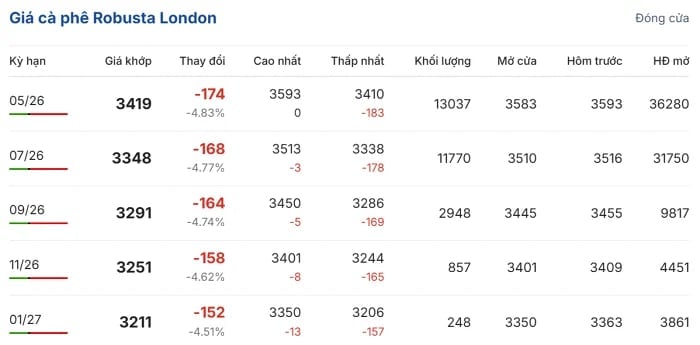
Robusta coffee prices on the London Exchange during the trading session on March 30. (Source: giacaphe.com)
On the New York exchange, arabica coffee prices for May 2026 delivery also declined by 3.02% (9.15 cents/pound), to 292.55 cents/pound. The July 2026 contract decreased by 3.13% (9.3 cents/pound) to 286.6 cents/pound.
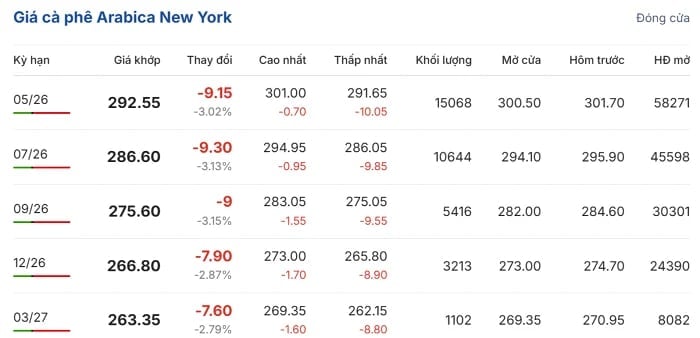
Arabica coffee prices on the London Exchange during the trading session on March 30. (Source: giacaphe.com)
Global coffee prices continue a downward trend in the latest session, reflecting investor sentiment amid supply fluctuations.
Coffee prices are under pressure due to expectations of a record crop this year in Brazil, the world’s largest producer, although in the short term supply remains tight as farmers are reportedly delaying sales.
Global coffee prices have recently turned lower as a wave of long-position liquidation has appeared in the futures market. According to Reuters and Barchart, profit-taking sentiment has increased as the market expects diplomatic efforts between the United States and Iran to ease tensions, potentially reopening the Strait of Hormuz – a key shipping route that had been disrupted.
Coffee prices also declined sharply as the USD Index rose to its highest level in 10.5 months.
However, the market was partly supported by information that robusta inventories on ICE fell to a 3.5-month low, reaching 4,109 lots as of March 30. In contrast, arabica inventories on ICE increased to a 6.25-month high, reaching 585,621 bags on March 18.
In addition, according to weather agency Somar Meteorologia, the Minas Gerais region – the largest arabica-growing area in Brazil, which received only 11.7 mm of rainfall last week, equivalent to 47% of the historical average.
The closure of the Strait of Hormuz has disrupted global transportation and tightened coffee supply. This situation has increased shipping, insurance, and fuel costs, thereby raising costs for importers and coffee roasters.
Notably, inventories at Cooxupe are currently nearly depleted after the unfavorable 2025 crop and strong demand. This means that new supply from the upcoming harvest will quickly enter the market, adding further downward pressure on prices.
On the other hand, exporting companies are forced to shift their sourcing strategy. As domestic delivery progress slows, many traders have turned to purchasing robusta from Indonesia and Brazil to fulfill contracts. This explains why Vietnam’s export prices continue to maintain a premium of $ 50–$ 100/ton over the May contract on the London exchange, while liquidity has not improved.
The market’s focus is now on Brazil, the country that could shape global price trends in the upcoming crop year. Many organizations forecast production for 2026–2027 at around 74 million bags, a sharp increase compared to the previous crop. If this scenario materializes, the market could shift into a surplus of up to 8.7 million bags, putting downward pressure on prices in the medium term.
Thus, global coffee prices on March 31, 2026 decreased slightly compared to the previous day.

Coffee prices on March 31, 2026: Plunge across trading exchanges
Coffee prices on March 31 domestically
In the domestic market, coffee prices on March 31, 2026 ranged from VND 91,700 – 92,500/kg, increasing slightly by VND 200/kg in Lam Dong and remaining stable in other localities.
Specifically, in Dak Nong (now Lam Dong), coffee is being purchased at VND 92,500/kg – the highest among key coffee-growing regions. In Dak Lak and Gia Lai, prices are at VND 92,300/kg.
Meanwhile, Lam Dong recorded a slight increase of VND 200/kg, with prices around VND 91,700/kg.
At the same time, Kon Tum remains at a lower level, with prices around VND 92,000/kg.
According to traders, the domestic coffee market is showing signs of adjustment after a relatively strong increase in the previous week, as many businesses and investors become more cautious amid fluctuations in the international market.
$ 1 = VND 26,107 – Source: Vietcombank.
Agriculture News | Agri Products Price