



(VAN) If the Middle East conflict persists, the global economy may weaken, reducing demand for industrial products, negatively impacting the rubber market.
According to the Agency of Foreign Trade (Ministry of Industry and Trade), Viet Nam’s rubber exports in March 2026 were estimated at about 130,000 tons, valued at $ 248 million, up 23.5% in volume and up 18% in value compared to March 2025.
In total, in Q1/2026, Vietnam’s rubber exports were estimated at 411,000 tons, valued at $ 752 million, up 8% in volume and up 2.4% in value compared to the same period in 2025.
The average export price of rubber in Q1/2026 reached $1,828/ton, down 5.1% from Q1/2025. In March 2026 alone, the export price averaged $ 1,909/ton, down 4.5% year-on-year, but up 2.9% compared to the previous month. This increase was mainly due to tightening supply from seasonal factors, as rubber trees entered the leaf-shedding phase and yielded lower output. In addition, rubber prices were also supported by the conflict in the Middle East. As synthetic rubber is produced from petroleum, rising oil prices increased production costs, prompting manufacturers to shift to natural rubber, thereby supporting natural rubber prices in the international market.
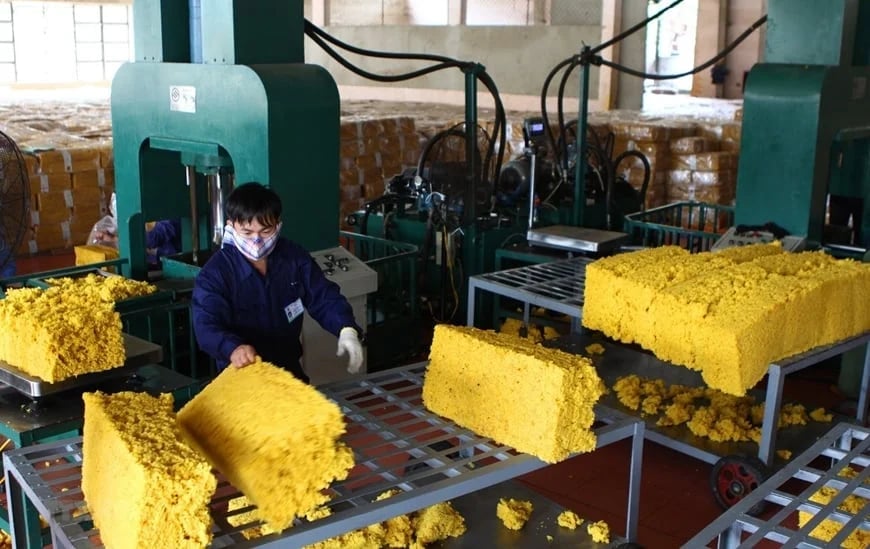
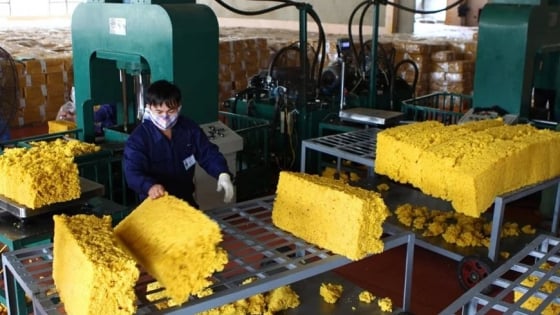
Vietnam’s rubber exports in Q1/2026 were estimated at 411,000 tons, valued at $ 752 million. Illustrative photo.
However, if the conflict persists, the global economy may slow, reducing demand for industrial products such as tires and, in turn, negatively affecting the rubber market.
According to analytics firm Bernstein, many international automakers are facing risks of business disruption due to the impact of the conflict in the Middle East, notably Toyota, Hyundai, Chery, and Stellantis. One of the main reasons is the disruption of maritime traffic through the Strait of Hormuz, a strategic maritime route connecting the Persian Gulf to international markets.
In addition to oil, this is also an important route for transporting automobiles and components to and from the Middle East. Meanwhile, the Middle East has been one of the largest and fastest-growing automotive markets in recent years. In 2025, the region consumed about 3 million new vehicles, of which Iran alone accounted for up to 38% of total sales.
The conflict has driven oil prices sharply higher, increasing transportation and production costs, thereby raising vehicle prices and operating costs. This may weaken demand for automobiles, especially for internal combustion engine vehicles that consume a lot of fuel.
Facing logistics risks and market volatility, some automakers have begun adjusting their production plans. Toyota may cut about 40,000 vehicles from its production plan to prepare for potential logistics disruptions in the Middle East. According to Bernstein, if the conflict continues and oil prices remain high, energy inflation could weaken global consumer confidence, thereby reducing demand for cars in many other markets.
Overall, the rubber market is being affected by a mix of short-term supportive factors and long-term risks, particularly geopolitical fluctuations and global industrial demand, requiring businesses to proactively adapt, diversify markets, and enhance resilience to unpredictable changes.
$ 1 = VND 26,112 – Source: Vietcombank.
Agriculture News | Agri Products Price