



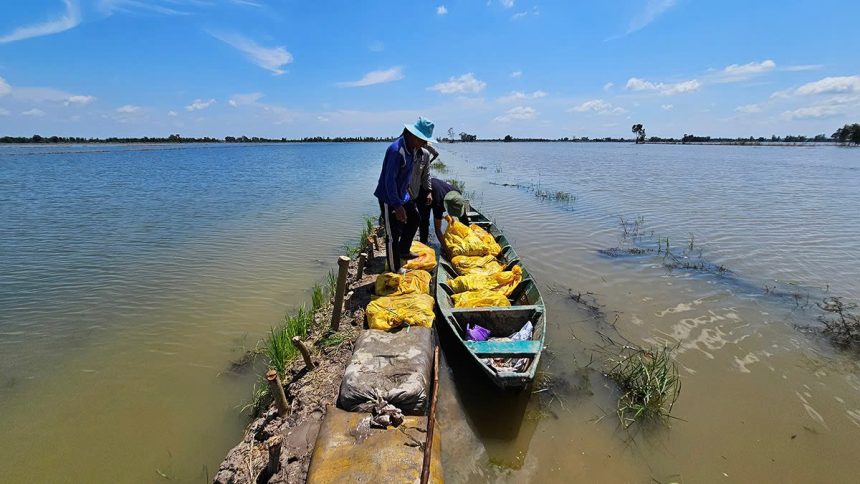
Floods combined with high tide are at risk of 220 dikes with a total area of more than 56,000 hectares of rice, crops and fruit trees in the Mekong Delta.
Information was issued by the Department of Irrigation Management and Construction (Ministry of Agriculture and Environment) at the Preliminary Conference of Crop production in 2025, implementing the Winter-Spring Plan 2025-2026 held in Dong Thap, September 9.
According to the forecast, flood peaks in Tan Chau and Chau Doc will appear at the end of September to the first half of October, higher than last year but still lower than average for many years. The water level in Tan Chau reached 3.50-3.70 m (higher than last year 0.12-0.32 m); At Chau Doc 3.30-3.50 m (higher than 0.19-0.36 m). In particular, Can Tho City is forecasted to be the most affected, with 116 boxes of De Bao, an area of more than 21,700 ha.
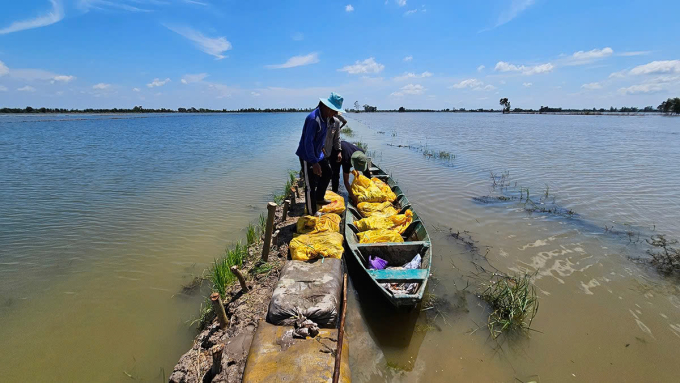
Farmers in Binh Hiep commune reinforced the shore to protect rice in the flood season in 2024. Photo: Nam An
Regarding saline drought, the upper Mekong reservoirs are currently storing about 50/65 billion m3, equivalent to 77% of the capacity. In the first half of the dry season 2025-2026, the average flow at Kratia Station (Cambodia) reached about 5,800 m3/s, 8% higher than the same period; The second half of the dry season reached 4,500 m3/s, 6%higher.
However, the Cambodian Beach Capacity is forecasted to reach only 35-40 billion m3, lower than the average of 5-7 billion m3 and lower than last year 6-9 billion m3. Therefore, the risk of early invasion saline still exists.
According to the forecast, in early 2026 salinity 4 ‰ at the Mekong estuaries can penetrate 40-50 km deep, 5-20 km lower than the same period of years. In Vam Co River, 4 ‰ saline boundaries at 30-35 km, has not affected the water to get water of irrigation works.
The agricultural sector assessed that the next dry season will be more convenient, but noted the risk of abnormal fluctuations due to the operation of the upstream hydroelectric reservoir, low flow or small floods. The localities are recommended to proactively store water, operate the work properly and plan the crop from the beginning of the dry season.
Thuong Son