



(VAN) Domestic coffee prices on April 17, 2026, surged by VND 1,200–1,300/kg, with price levels ranging between VND 87,900 and 88,400/kg.
Coffee prices on April 17 globally
Global coffee prices today declined, with this commodity reversing and falling simultaneously on both the London and New York exchanges.
On the London exchange, robusta prices dropped notably across delivery terms. Specifically, the May 2026 contract fell by $ 54/ton (-1.52%) to $3,474/ton; the July 2026 contract decreased by $47/ton (-1.37%) to $3,347/ton; the September 2026 contract declined by $44/ton (-1.31%) to $ 3,278/ton; and so on.
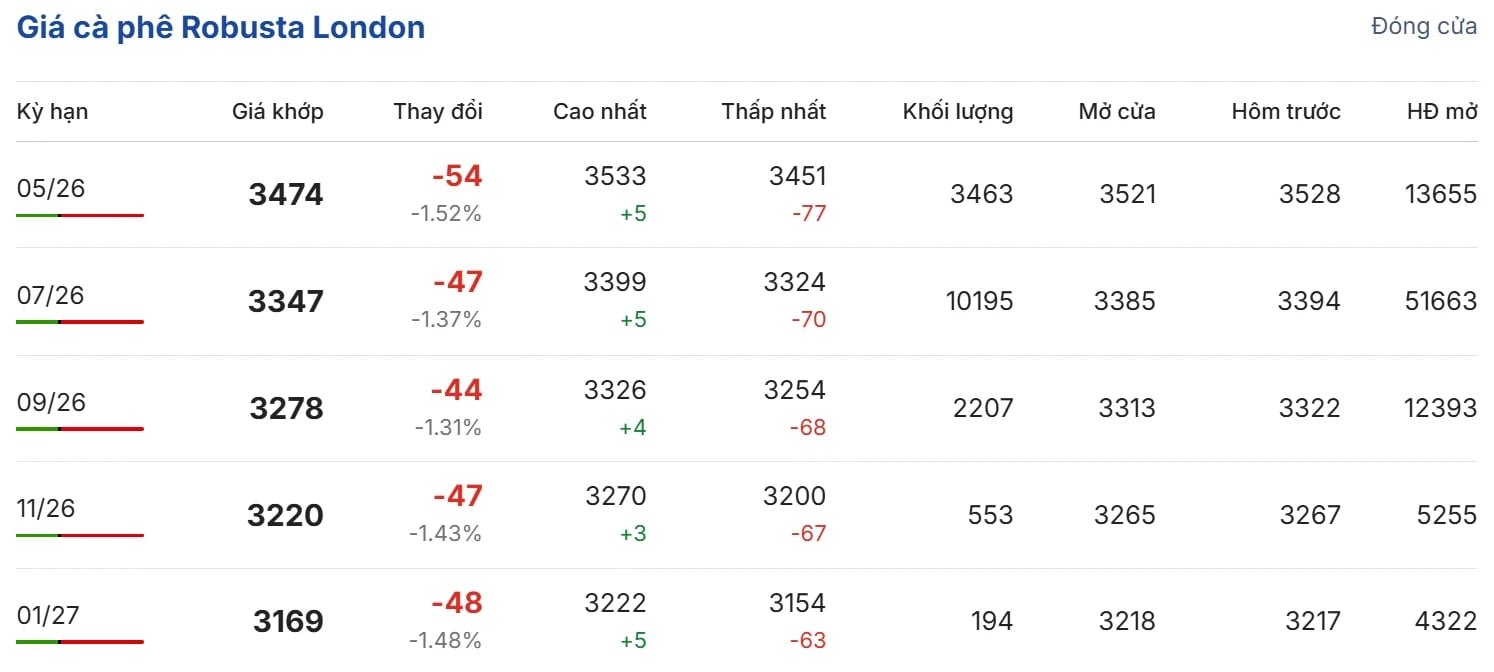
Robusta coffee prices on the London exchange. Source: giacaphe.com.
Similarly, on the New York exchange, arabica prices also turned sharply lower. The May 2026 contract dropped by 7.80 cents/lb (-2.55%) to 296.45 cents/lb; the July 2026 contract fell by 7.85 cents/lb (-2.62%) to 290.40 cents/lb; the September 2026 contract decreased by 6.75 cents/lb (-2.37%) to 277.35 cents/lb; and so on.
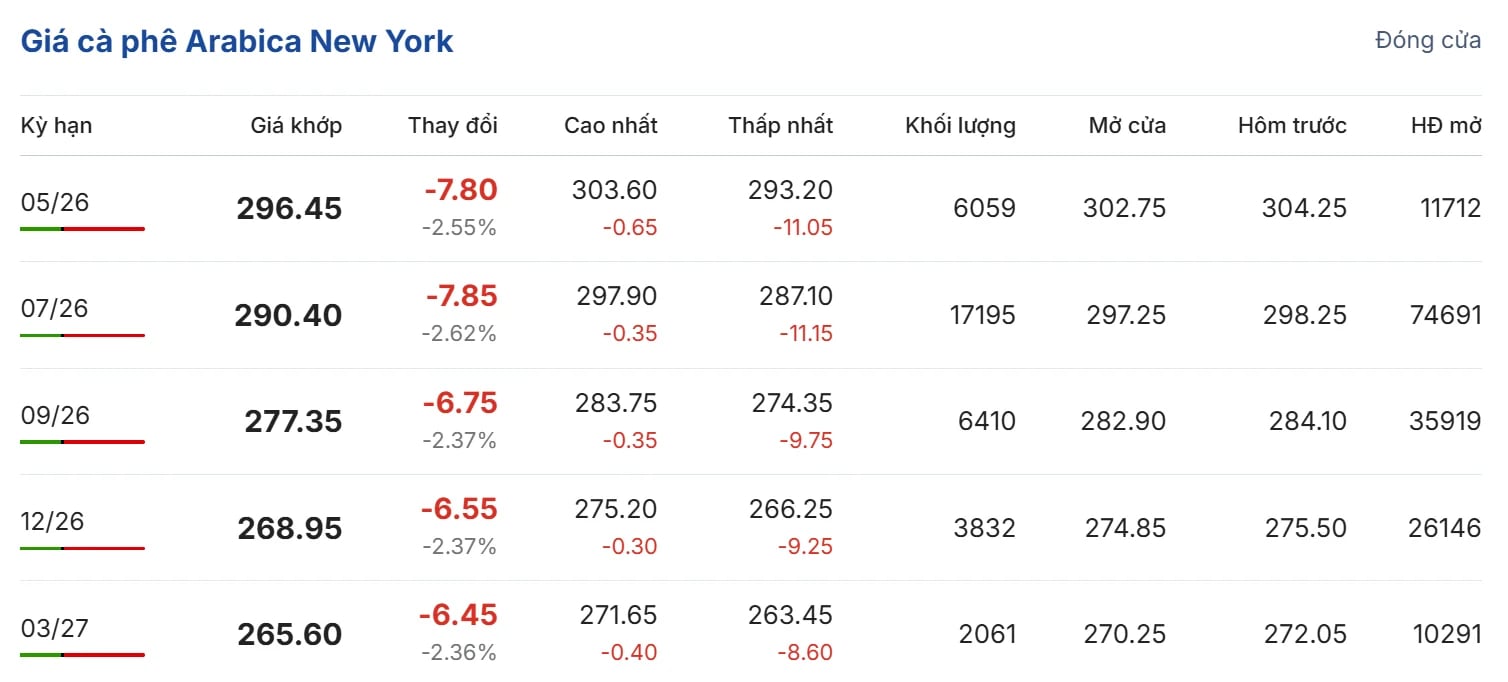
Arabica coffee prices on the New York exchange. Source: giacaphe.com.
Overall, global coffee prices on April 17 closed the session with a downward adjustment, as prices on both exchanges declined. However, the market has not fully turned bearish, as supportive factors remain in place, keeping prices volatile.
The biggest pressure currently comes from supply, particularly from Brazil, the world’s largest coffee producer. According to Safras & Mercado, the new crop output has been revised up by 4.65 million bags to a record 75.65 million bags (60 kg each). Notably, the 2026–2027 crop is expected to increase by 17% compared to the previous season, with arabica reaching 49.95 million bags (up 29%), while robusta is projected at 25.7 million bags (down slightly by 1.2%).
This outlook has made arabica’s upward momentum more cautious, as the market needs to absorb the prospect of oversupply in the coming period. Seasonal factors are also shifting from supportive to pressuring, as Brazil enters its harvest period, improving supply conditions.
However, a notable point is that Brazilian farmers’ selling pace remains slow, with only about 14% of the expected output sold, well below the five-year average of 23%. This indicates a tendency to hold inventory in anticipation of higher prices, helping to limit deeper declines.
On the demand side, consumption trends are also evolving. A survey by the National Coffee Association of the United States shows that 85% of consumers drink coffee at home, the highest level since 2012, with an average consumption of 2.8 cups per day, equivalent to over 500 million cups daily, continuing to provide stable demand for the market.
Thus, global coffee prices on April 17, 2026 recorded a downward adjustment across major exchanges.
Coffee prices on April 17, 2026: Continue to rise sharply.
Coffee prices on April 17 domestically
In Vietnam, domestic coffee prices today (April 17, 2026) continued their upward trend, rising by VND 1,200–1,300/kg compared to yesterday morning, reaching VND 87,900-88,400/kg.
Specifically, in Dak Nong (now Lam Dong), coffee is being purchased at VND 88,400/kg, the highest among key coffee-growing regions. In Dak Lak and Gia Lai, prices increased by VND 1,200/kg to VND 88,300/kg.
Meanwhile, Lam Dong remains the lowest-priced locality, with trading levels around VND 87,900/kg.
$1 = 26,357 VND (source: Vietcombank).
Agriculture News | Agri Products Price