



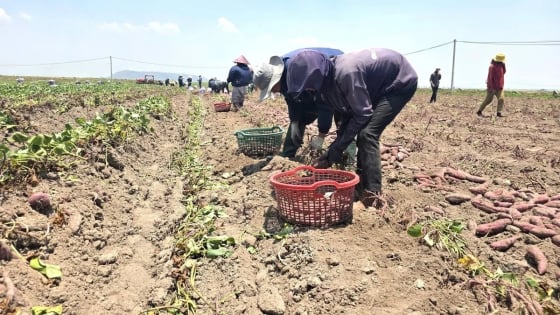
(VAN) Sweet potato prices in Phu Thien (Gia Lai) have plunged during the main harvest season due to oversupply, putting farmers at risk of losses.
Prices drop by nearly half, down to just VND 5,000-6,000/kg
These days, the sweet potato harvest is in full swing across fields stretching through Phu Thien, Chu A Thai, and nearby areas of Gia Lai province. Under scorching heat reaching up to 39°C, farmers are still working tirelessly to collect every tuber in time for transportation and sale. However, unlike the usual bustling atmosphere, this year’s harvest feels more subdued as concerns over falling prices weigh heavily on growers.
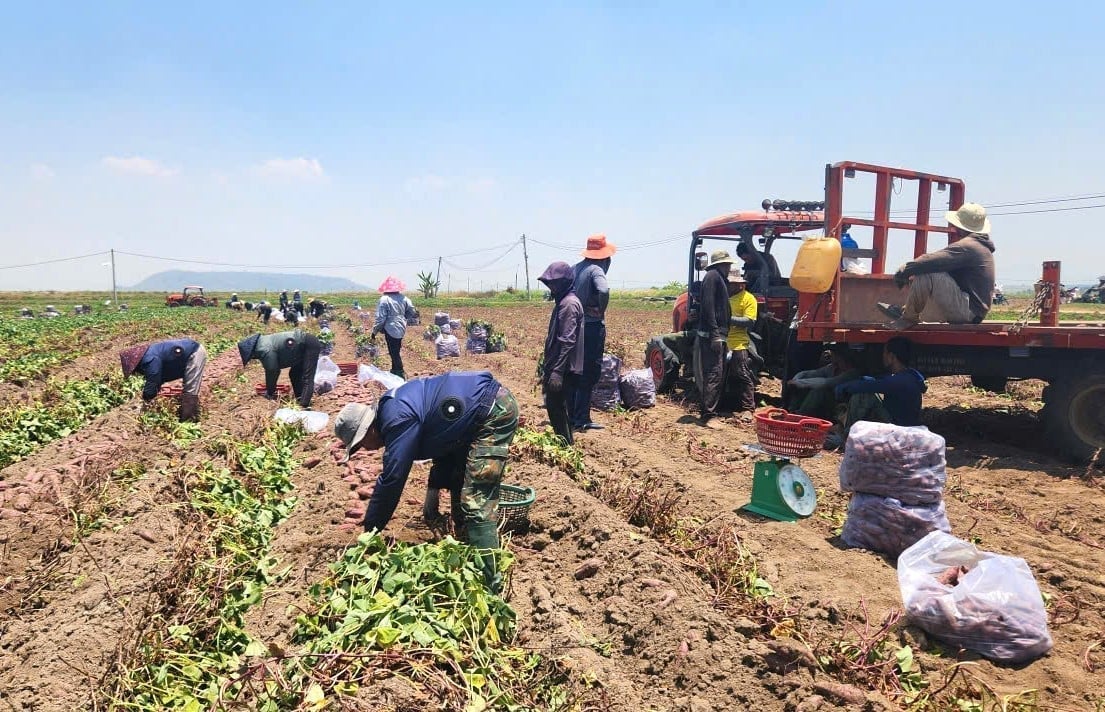
In the fields, farmers are busy harvesting sweet potatoes. Photo: Tuan Anh.
According to observations, sweet potato prices have dropped sharply compared to about a month ago. Previously purchased at over VND 10,000/kg, the price has now fallen to just VND 5,000-6,000/kg. At this level, many farmers say they are barely breaking even, or even facing losses, especially those renting land for cultivation.
This reality has taken a toll on the harvest season. Across many fields, it is not hard to see the चिंता and heavy-hearted expressions of farmers. In Kim Mon hamlet (Chu A Thai commune), the harvest continues at a rapid pace, with dozens of workers picking potatoes into plastic bags while tractors stand ready to transport them to collection points and load them onto waiting trucks.
Standing in his family’s field, Mr Pham Van Vien reflected on the continuous price decline. Since last October, his family has invested in planting more than 16 hectares of sweet potatoes, hoping for a successful season. About a month ago, when prices reached VND 16,000/kg and yields were around 30 tons per hectare, expectations were high. However, by harvest time, prices dropped to VND 8,000/kg and have now fallen further to just VND 5,000/kg.
“On average, each hectare costs over VND 100 million to invest. A few days ago, at VND 8,000/kg, we still made a small profit. Now at VND 5,000/kg, there’s basically no profit, even losses,” he shared.
He added that the sharp decline is mainly due to rising transportation costs as fuel prices increase, combined with rapidly expanding cultivation areas leading to oversupply.
In the fields of Thang Loi 1 hamlet, Phu Thien commune, the harvest continues, but anxiety is evident on farmers’ faces. Many are harvesting while closely watching market prices, hoping for even a slight improvement in income.
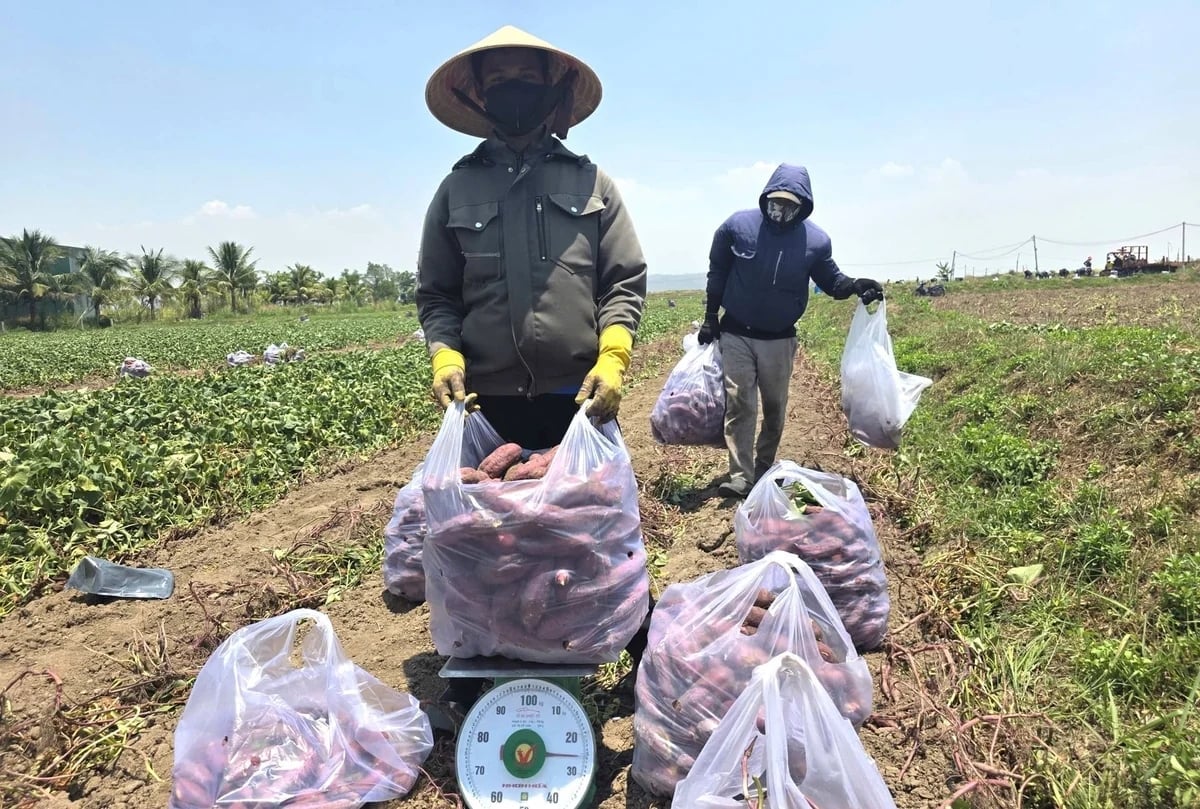
Some fields have good yields, but prices are dropping sharply. Photo: Tuan Anh.
Ms Pham Thi Linh, a farmer in Thang Loi 1, expressed her frustration: “At current prices, making a profit is nearly impossible. Those renting land are at risk of heavy losses.”
She said her family has 3 hectares ready for harvest but is trying to delay selling in hopes that prices may recover slightly. At the current level of around VND 5,000-5,500/kg, economic efficiency is almost nonexistent.
“We’re trying to hold on and wait for prices to improve. Selling now means losing capital. Fuel prices are rising, all input costs are increasing, while sweet potato prices keep falling. It’s really difficult for farmers,” she said.
The need for linkage to ensure sustainable development
With years of experience in trading sweet potatoes, Ms Ma Thi Thom in Chu A Thai commune said the market is currently unstable as prices continue to decline daily. She is buying at VND 6,000/kg, higher than the general market, but still struggles to find buyers.
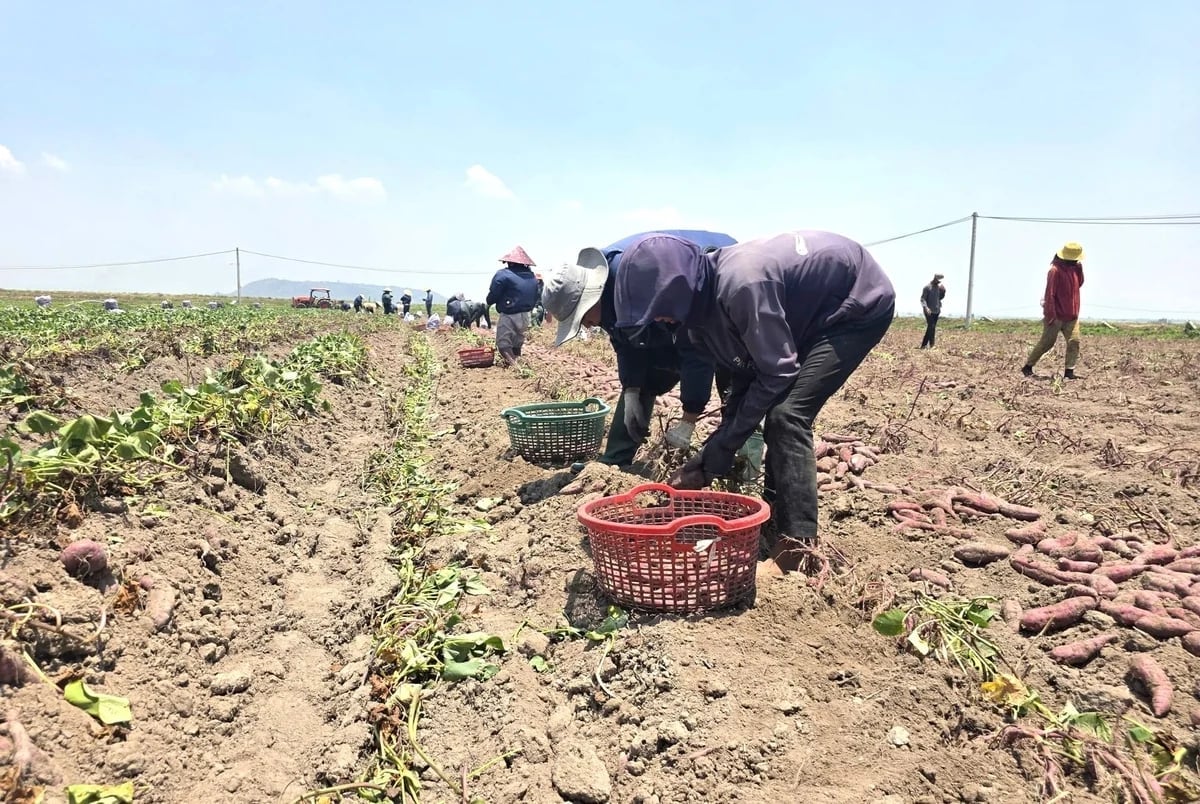
Sweet potato cultivation in Phu Thien and surrounding areas covers nearly 2,000 hectares. Photo: Tuan Anh.
According to her, only well-managed fields with yields of around 30 tons per hectare can generate slight profits at current prices. Rising fuel costs have significantly increased transportation expenses, while hot weather has reduced demand in key northern markets, directly affecting sales.
“We’re still trying to buy from farmers, but honestly, traders are not making profits either,” she said, adding that she purchases around 25 tons/day, far below farmers’ supply needs.
Mr Do Van Nam, Director of Phu Thien Safe Agricultural Cooperative, said the total sweet potato area in Phu Thien and nearby regions is nearly 2,000 hectares. The current price drop is mainly due to peak harvest season, when output surges while consumption cannot keep up.
He explained that sweet potatoes are typically planted around October (lunar calendar) and are now harvested simultaneously. In addition to oversupply, consumption in northern markets has slowed due to hot weather. Moreover, the lack of production linkage, where farmers grow independently without coordination, has led to the uncontrolled expansion of planting areas.
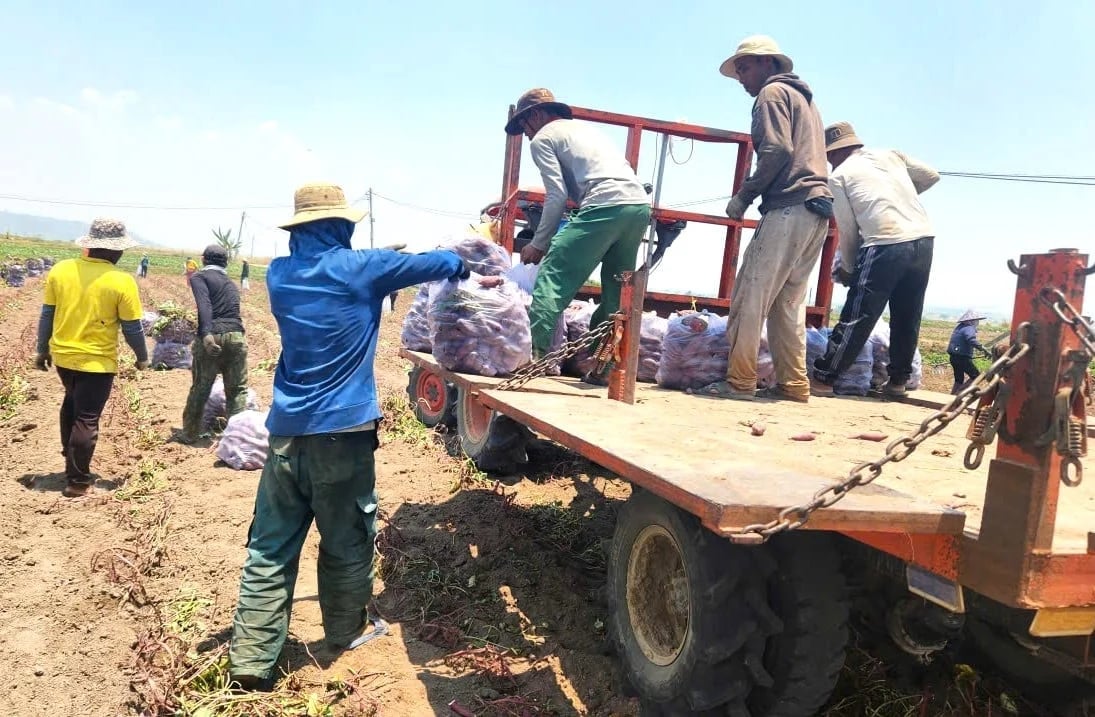
Sweet potatoes are mainly consumed in northern provinces and exported to China. Photo: Tuan Anh.
Mr Nam suggested that to stabilize the industry, part of the cultivation area should shift to other crops with similar value. However, many farmers are reluctant to change due to familiarity with sweet potato farming. “The key issue is whether farmers are truly willing to switch crops. Otherwise, sweet potatoes will struggle to develop sustainably,” he noted.
Mr Mai Ngoc Quy, Head of the Economic Department of Phu Thien commune, said the commune currently has about 800 hectares of sweet potatoes. Recently, prices have dropped continuously, directly affecting farmers’ incomes. The main cause is rising fuel prices leading to higher transportation costs, along with cases of traders taking advantage of the situation to pressure farmers into lower prices.
To ensure more stable and sustainable development of the sweet potato sector, he emphasized the need to strengthen production and consumption linkages from the beginning of the season. Businesses could provide advance deposits, and once economic efficiency is proven, authorities can encourage farmers to participate in structured production models. At the same time, farmers should avoid breaking contracts when prices rise.
“In the coming time, the locality will guide farmers in selecting high-quality varieties suitable for local conditions to improve productivity and product quality. This way, even when market prices fluctuate, farmers can better cover costs and reduce the risk of losses,” he added.
* $1 = VND 26,361 – Source: Vietcombank.
Agriculture News | Agri Products Price