

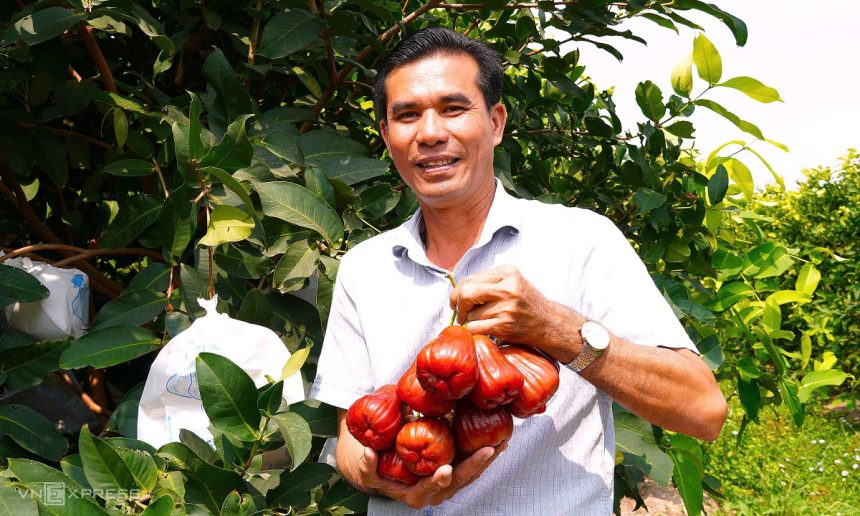
Can ThoAfter many years of research and cross-breeding, Mr. Tran Van Phuc has succeeded with the San Tien pink plum variety, the selling price of which is many times higher than that of conventional varieties.
In the days approaching Tet, the 50-hectare San Tien pink plum garden of Mr. Phuc, 51 years old, in An Quoi hamlet, Cu Lao Dung commune, entered peak harvest. From early morning, dozens of workers are busy cutting fruit, sorting, and packaging to promptly deliver goods to customers in Hanoi and Ho Chi Minh City.
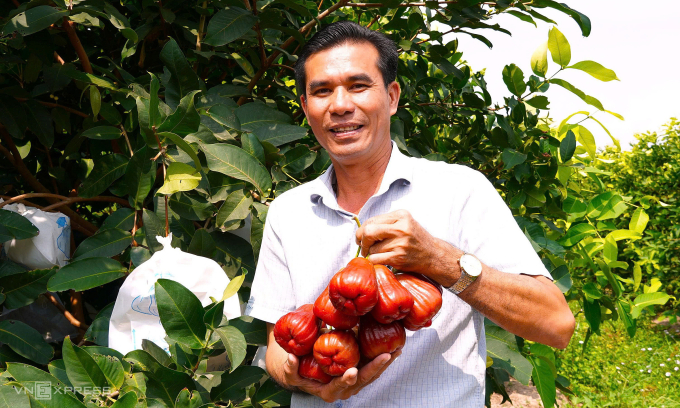
Mr. Tran Van Phuc checks plums preparing for harvest. Image: Cheers Ly
Mr. Phuc is called “barefoot engineer” by local people. Without formal training, he succeeded with the Ido longan variety that is drought- and salt-resistant and resistant to dragon broom disease. When consumer tastes changed, he switched to producing organic fruits, focusing on health values.
In 2018, from the desire to create a fruit suitable for people with diabetes, he began researching plum trees. After many years of studying documents and learning from many localities, from the original An Phuoc plum, he successfully bred the pink plum variety, selling it to the market at a price many times higher than the popular variety.
By 2023, he continued to improve and launch the San Tien pink plum variety, which has been registered as an exclusive trademark. “It took me nearly 5 years, testing about 10 different varieties to choose the one I like,” he said.
San Tien pink plums have a dense, crispy flesh, are sweet, lightly fragrant, and twice as sweet as An Phuoc plums. This variety tolerates drought and salinity well, adapting to salinity levels up to 10 parts per thousand. Organic farming helps the fruit have a beautiful red color, with a preservation time of up to 30 days in cool storage and about 4 days in natural conditions, convenient for long-distance transportation and export orientation.
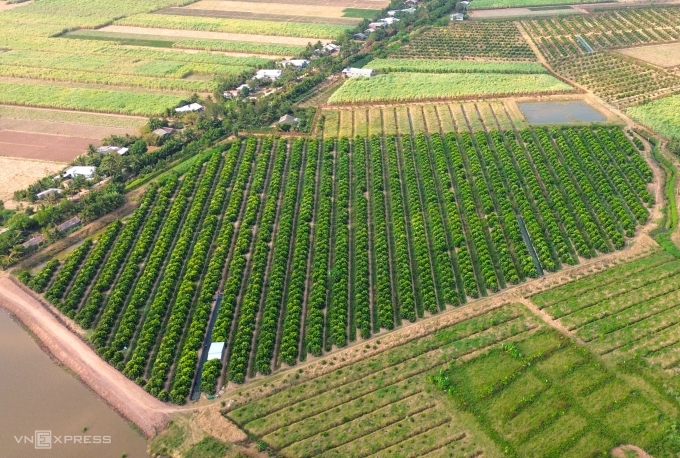
San Tien pink plum garden is dozens of hectares wide on the island. Image: Cheers Ly
Right from the pollination stage, the fruit is covered with mesh, then replaced with paper bags to limit insects, reduce residue and help develop beautiful color. Each fruit is numbered to manage yield. After harvest, plums are labeled with a QR code to trace their origin, showing full information about the garden, production process and harvest lot.
5 days before harvest, plum samples are tested for residue to ensure food safety. Thanks to strict control processes, the product is trusted by consumers and willing to pay high prices.
According to Mr. Phuc, the investment cost is about 400 million VND per hectare. After three years, the plum garden produces stable fruit and profits can reach about 2 billion VND per hectare per year. In the first crops, the output was not enough to supply, mainly consumed in Hanoi and Ho Chi Minh City through high-end fruit stores.
Currently, he harvests about 20 hectares of plums and promotes exports to England, France, Korea and the Middle East. If it meets technical requirements, the first shipment is expected to be exported to the UK by air.
Each 24–36 month old plum tree produces 35–40 kg of fruit per crop. On average, 1,000 m² yields 4 tons, but he only retains about 2 standard tons, equivalent to 20 tons per hectare. The largest fruit weighs about 250 grams, priced at 230,000 VND per kg; 150 grams cost 150,000–160,000 VND per kg.
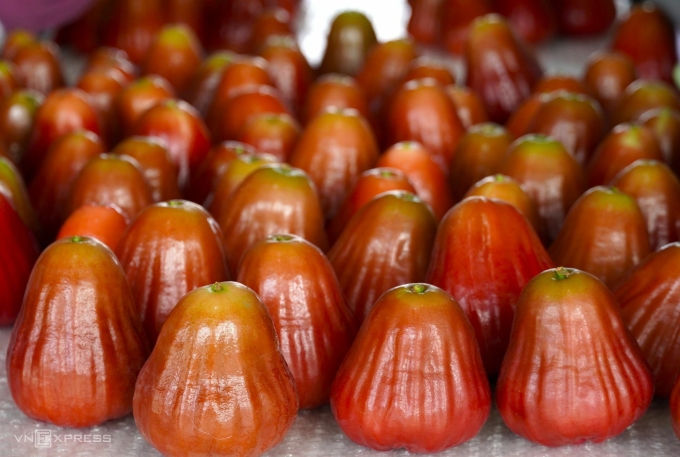
San Tien pink plum has a beautiful color, is crispy, and sweet. Image: Cheers Ly
The entire garden is managed digitally. From the fruit packaging stage, data is entered into the system, helping to forecast output 30 days in advance, proactively offer and deliver goods, not depending on traders. According to Mr. Phuc, this is a mandatory condition if you want to put agricultural products on the e-commerce platform.
At the same time, he tested the greenhouse model on an area of 1,000 m2 to control rain, humidity and fruit quality. If effective, the model will be replicated even though the investment cost is about 4 billion VND per hectare.
To cope with saltwater intrusion, he set aside 20–30% of the area to dig lakes to store fresh water, combine fish farming and develop agricultural tourism. “If done correctly, the value of agricultural products will increase many times,” he said, stating the goal of building a closed production – retrieval – consumption chain, moving towards linking with local farmers for sustainable development.
Cheers Ly