


Can ThoMr. Le Vu Phuong, 45 years old, many years tinkering with the way to raise ducks, linking farmers to sell products to the restaurant, each year profit hundreds of millions of dong.
Duck breeding area is more than 4,000 m2 of Mr. Phuong in Phuoc An B hamlet, My Phuoc commune (My Tu district, old Soc Trang), becoming a place where many farmers come to learn to raise ducks and buy breeds.
Before sticking to this model, Mr. Phuong tried many ways to do business such as breeding of copper fish, sea ducks, planting … but the effect is not high. In 2015, seeing a relative who bought breeds from the North to try, he began to be interested. Initially, he used about 400 m2 to raise 40 mallard ducks.

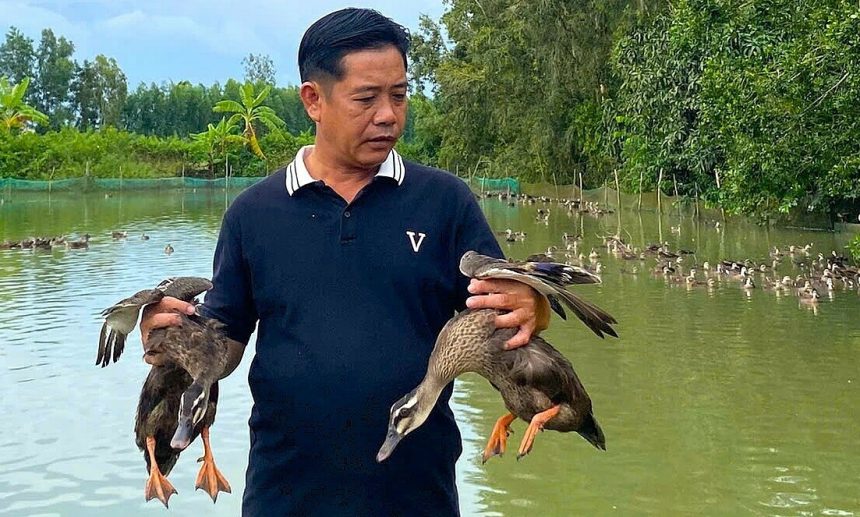
Le Vu Phuong’s breeding duck farming is covered by the surrounding net. Image: Wish Ly
Due to his lack of farming experience, ducks did not develop well. Not giving up, he went to many places to visit and buy varieties from many different sources, but the survival rate was still low because the duck had to transport far away, not suitable for local conditions.
By 2017, from the remaining ducks, Mr. Phuong tried to hatch eggs to take the initiative in the breed. Supported by the district and experts from Can Tho University, he persisted in research. During four years, the expansion rate was often low, many times he wanted to give up. After technical adjustment, about 5 years now, the expansion rate reaches 80%.
According to Mr. Phuong, hatching duck eggs is harder than normal ducks, having to go through many stages such as egg stirring, washing, dipping with high accuracy. He currently has three incubators, each batch on average 7,000 eggs. With a breeding of 650 ducks, he supplies about 3,500-4,000 breeds per month for guests in Can Tho, Ca Mau, Vinh Long, priced at 12,000 VND a child.

Snake ducks are currently sold by Mr. Phuong for 12,000 VND each but not enough to supply. Image: Wish Ly
In addition to providing seeds, he also taught technical and product consumption for farmers. Dozens of households in the area participated in linking and raising commercial ducks sold to restaurants and tourist areas, exporting about 2,000 children per month.
The price of commercial ducks was purchased by Mr. Phuong 75,000-80,000 VND per head (900 grams to one kilogram). Thanks to the chewy, sweet, firm meat, the ducks are favored by the restaurant, the retail price of 350,000 VND per child. The output currently only meets about 30% of the demand.
In farming techniques, the mallard ducks drop 55-60 days to reach the weight of sale. At this stage, the wings are not long, so the duck does not fly from the farming area. The survival rate reaches about 95%.
Farmers must hold ducks on the first three days, ensuring dryness, warm enough but no lights. As a child, ducks eat rice and mixed food, after 15 days can be released naturally. With wild properties, good resistance, little ducks, the cost of farming is only one third compared to regular ducks.
Each duck from farming to sale costs about 25,000 VND for breeding and food. Purchasing price 75,000-80,000 VND, farmers profit 40,000-50,000 VND per child. Many households in the area thanks to the duck raising have more stable income.
Adult mallard ducks eat rice, banana trees, shrimp, snails, and trash fish. To prevent disease, Mr. Phuong asked the farmer to be isolated and cleaned after each crop. The farming area needs a net to avoid flying ducks out.
Ducks for about 9 months have breed and last up to 5 years. 3-5 years old, the best ducks, high egg production. Each mother lay 11-12 eggs per batch, 1.5-2 months apart. After 3-4 days, the eggs were taken into the incubator, it took 28 days to hatch. Every three days, Mr. Phuong exported a batch of 300-400 heads.

Mr. Phuong checked the breeding duck. Image: Wish Ly
Thanks to the development of breeds, he linked many commercial farmers, creating a closed chain from production to consumption. Each year, his family earns hundreds of millions of dong profit from supplying seeds and selling commercials.
According to Mr. Phuong, the key to success is patience, mastering incubation techniques, taking care of ducks in the right process and having a stable output. “The most difficult farming is to find the market.
Mr. Tran Ngoc Giang Nam, Vice Chairman of the People’s Committee of My Phuoc Commune, said the commune encouraged people to raise ducks since 2018 after surveying the model in your province. With the local characteristics of low -lying areas, people take advantage of the source of existing trash fish as food.
“Thanks to the initiative, stable output, the model brings high efficiency, people excitedly replicate,” Mr. Nam said.
Wish Ly