

Durian prices dropped sharply, traders abandoned their deposits, and production costs increased, causing many Western gardeners to lose money and have to sell roadside retailers to raise capital.
For nearly a month now, Western farmers have entered the main durian harvest season, but prices have continuously plummeted. Currently, Ri6 durians purchased at the garden are only 20,000-30,000 VND per kg (sold in buckets), the lowest in many years and about 1/3 of the price during the Lunar New Year. Similarly, Monthong variety reduced to 70,000-80,000 VND per kg.
In key growing areas in Dong Thap and Can Tho, the harvest atmosphere is quite quiet. Many orchards have fruits that are ripe beyond the cutting date but traders have not yet purchased them, forcing garden owners to sell them to roadside retailers and rural markets to recover capital.
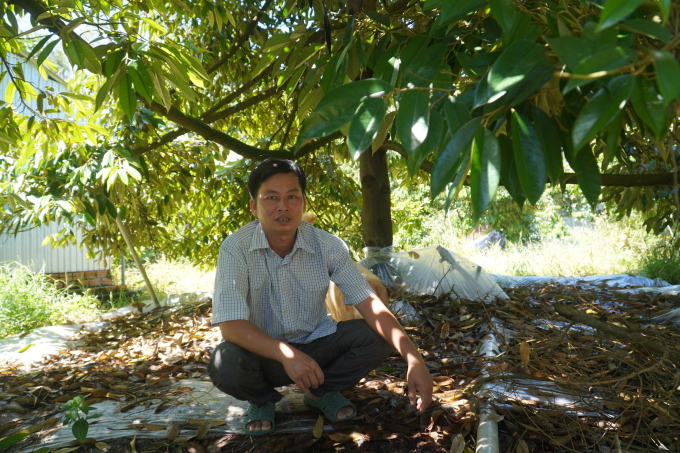
In this case, Mr. Nguyen Thanh Tam lost 180 million VND due to the sharp drop in durian prices. Image: Ngoc Tai
Mr. Nguyen Thanh Tam, growing 1.2 hectares of Ri6 durian in Tam Nong commune, Dong Thap, said he had just sold about 17 tons at the price of type A 29,000 VND per kg, type B only 15,000 VND. Because traders extended the harvest time, his garden lost about 3 tons of fruit.
According to Mr. Tam, the production cost of this crop is about 33,000 VND per kg, increasing because fertilizers and pesticides increased by 10-20% compared to before. At the current price, he lost about 180 million VND. “I have never seen durian as cheap as this year. At this price, farmers are devastated,” he said.
Similarly, Mr. Nguyen Van Giang, who grows one hectare of Monthong durian in Tan Phuoc commune, Dong Thap, said that half a month ago the price was set at 110,000 VND per kilogram but the trader kept moving the cutting date and then lost contact.
He contacted many other contacts but were all refused to purchase. The garden owner had to gradually cut down and sell at the commune market for 40,000-50,000 VND per kg, while there were still about 5 tons of fruit left on the tree. “If you don’t count the cost of care, it’s considered breaking even, old money is exchanged for new money,” Mr. Giang said.
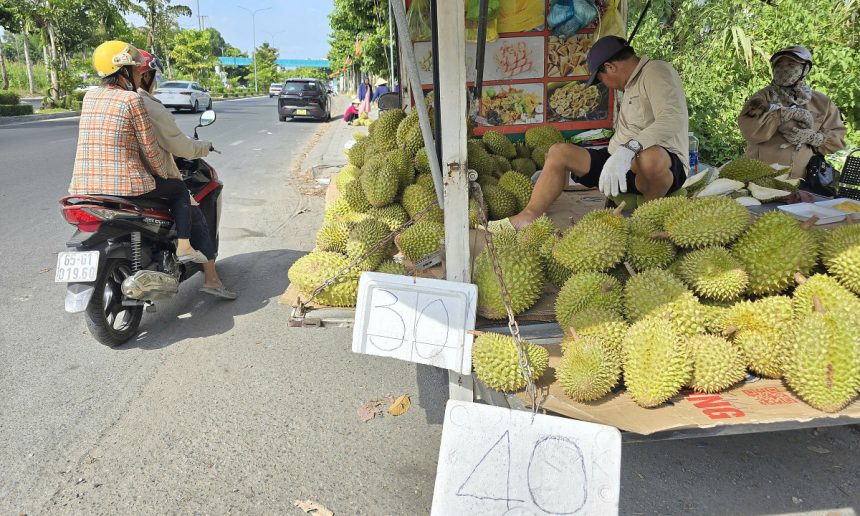
In Can Tho, many gardeners also sell durian on the roadside for 30,000-50,000 VND per kg. Ms. Phan Thi Dam said she had to sell retail because exporting was difficult, warehouses were not purchasing, and prices had dropped sharply. “Sold this way, it becomes common durian, not durian anymore,” she said.
According to statistics, Can Tho City currently has about 13,000 hectares of durian, with an output of nearly 95,000 tons per year. Dong Thap has about 32,000 hectares, of which more than 22,000 hectares are producing fruit, with an output of over 500,000 tons per year. In May and June alone, the whole province is expected to harvest about 110,000 tons.
According to the Department of Crop Production and Plant Protection, by 2025 the durian area in the country will exceed 150,000 hectares, concentrated in the Central Highlands, Mekong Delta and Southeast, double the planning orientation for 2030.
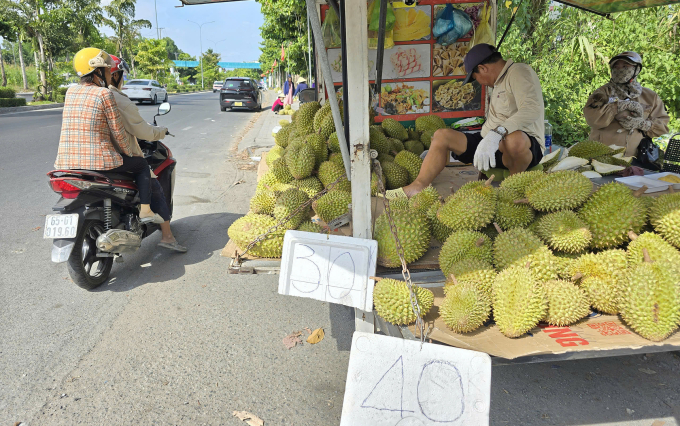
A place selling durian on Nguyen Van Cu Street, Can Tho City. Image: An Binh
Mr. Dang Phuc Nguyen, General Secretary of the Vietnam Fruit and Vegetable Association (Vinafruit), said durian prices have plummeted due to fierce competition with Thailand and many shipments were found to be contaminated with cadmium when exported to China.
According to Mr. Nguyen, although some batches have been tested before export, traders often buy from many gardens and then mix them at warehouses, causing sample testing to not accurately reflect the entire batch.
“After the Chinese side warned of the risk of withdrawing the license, many testing laboratories were afraid and did not even accept samples, causing export congestion and a sharp drop in prices,” he said.
In the long term, Mr. Nguyen believes that it is necessary to improve varieties, treat soil, remove banned substances and build a laboratory system in growing areas for farmers to proactively check before harvest. Only gardens that meet standards can export fresh fruit, while gardens contaminated with cadmium can be converted to processing.
“Thailand has licensed about 500 laboratories to support farmers and control quality right from the garden,” he said.
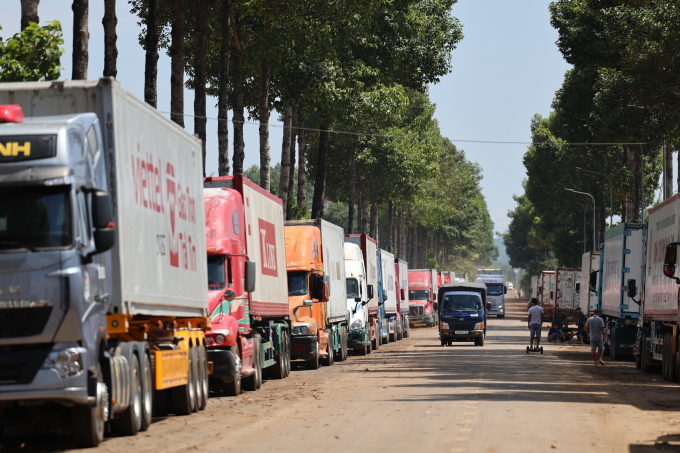
Durian container trucks are stuck in the Dau Giay area waiting for testing. Image: Phuoc Tuan
Dr. Tran Huu Hiep said that durian prices have plummeted and exports are facing difficulties not only due to short-term supply and demand but also reflects an unsustainable growth model, heavy dependence on the Chinese market, expanding the area too quickly and slowly standardizing quality.
According to him, production is still fragmented, many growing areas do not comply with synchronous farming procedures; Uncontrolled use of fertilizers and pesticides.
“Exporting requires chain management, data transparency and clear traceability, while currently there is still a strong situation where everyone does their own thing,” Dr. Hiep said.
He believes that Vietnamese durian is difficult to expand into high-end markets such as the EU, US, Japan or Korea due to much stricter technical standards. Currently, this industry mainly competes thanks to seasonal advantages and geographical location near China, but has not yet created an advantage in terms of brand and international standards.
According to Dr. Hiep, to expand the market, the durian industry needs to standardize quality according to international standards, invest heavily in deep processing and build a national brand. “This is no longer a story of the agricultural industry alone, but of national competitiveness,” he emphasized.
Ngoc Tai – Huy Phong