

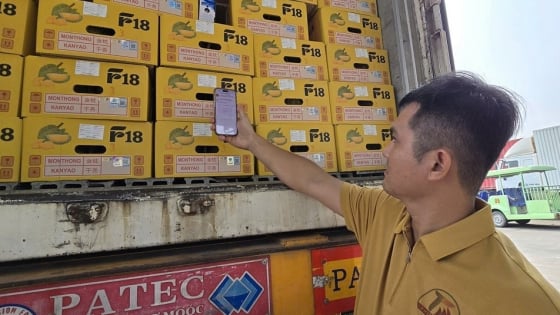
(VAN) After the ‘green lane’ durian shipment, enterprises are required to reorganize their production processes and strengthen information control.
From piloting to real-world pressure
Following the April 10 milestone, when the first durian shipment was cleared under the “green lane” procedure, the key question is no longer about feasibility, but about the level of adaptation in practice.
For businesses, this means a fundamental shift in how production and export activities are organized. According to Nguyen Ngoc Phu Qui, a representative of Thien Tam Agricultural Trading Co., Ltd., companies previously faced significant difficulties due to the lack of full control over information related to origin and production processes.
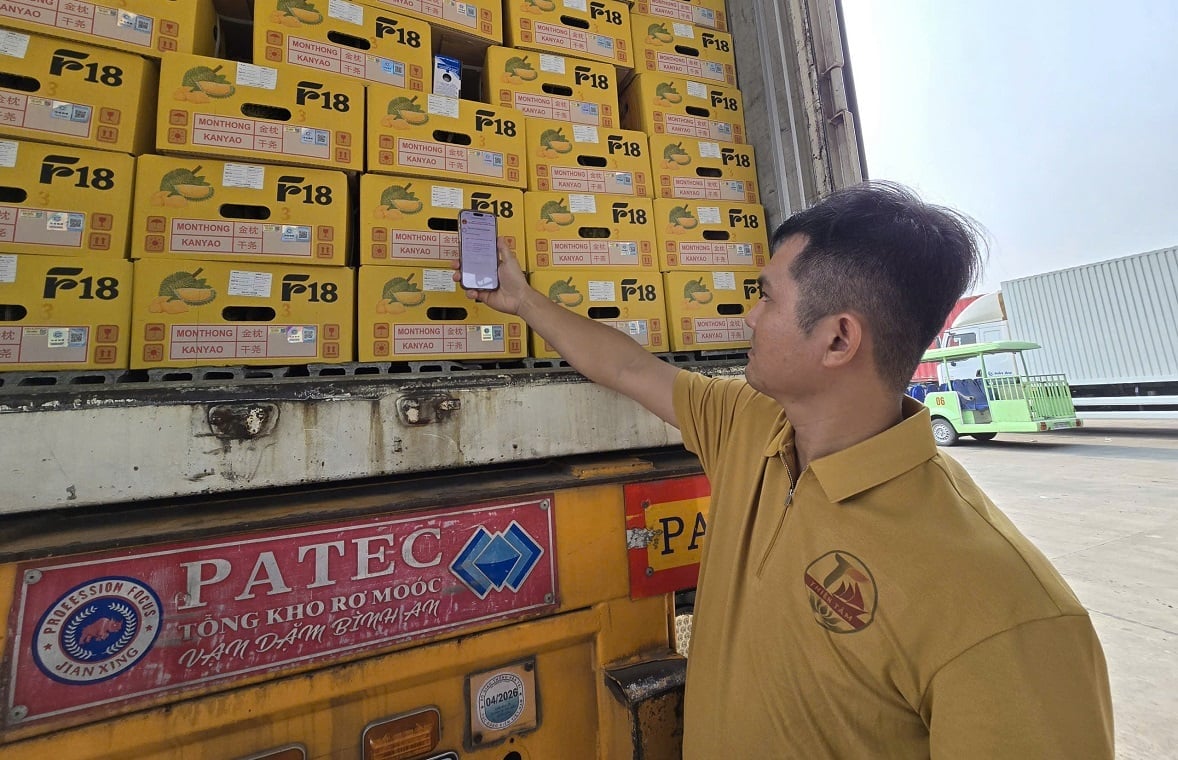
Scanning the QR code allows tracking of the product’s journey, ensuring the shipment transparency. Photo: Hoang Nghia.
When the new system is applied, all information about the shipment, from cultivation area to packaging and transportation, is clearly defined. This enables businesses to take a more proactive role in proving product quality and completing documentation.
However, achieving this requires companies not to participate only at the final stage, but to engage from the beginning, working closely with farmers and other stakeholders to control the process at its source.
Businesses reorganize the production chain
Under the new approach, enterprises become the central hub connecting all stages of production and export.
According to Mr. Qui, the company has coordinated with relevant authorities from the stage of purchasing at cultivation areas, to providing guidance on preservation and packaging, through to completing procedures in line with requirements.
This process demands close linkage between all stages. From sampling and supervised harvesting to on-site labeling and data updating, everything must be implemented in a synchronized manner. If any step fails to comply, the entire data chain will be affected.
From a business perspective, directly involved in the pilot, Mr. Tran Van Tuong, Director of Fruit Group 001 Co., Ltd. – one of the two companies whose shipments were among the first to be cleared under the “green lane” procedure, stated that assigning a unique identifier to each product makes it possible to track the entire journey from production to consumption.
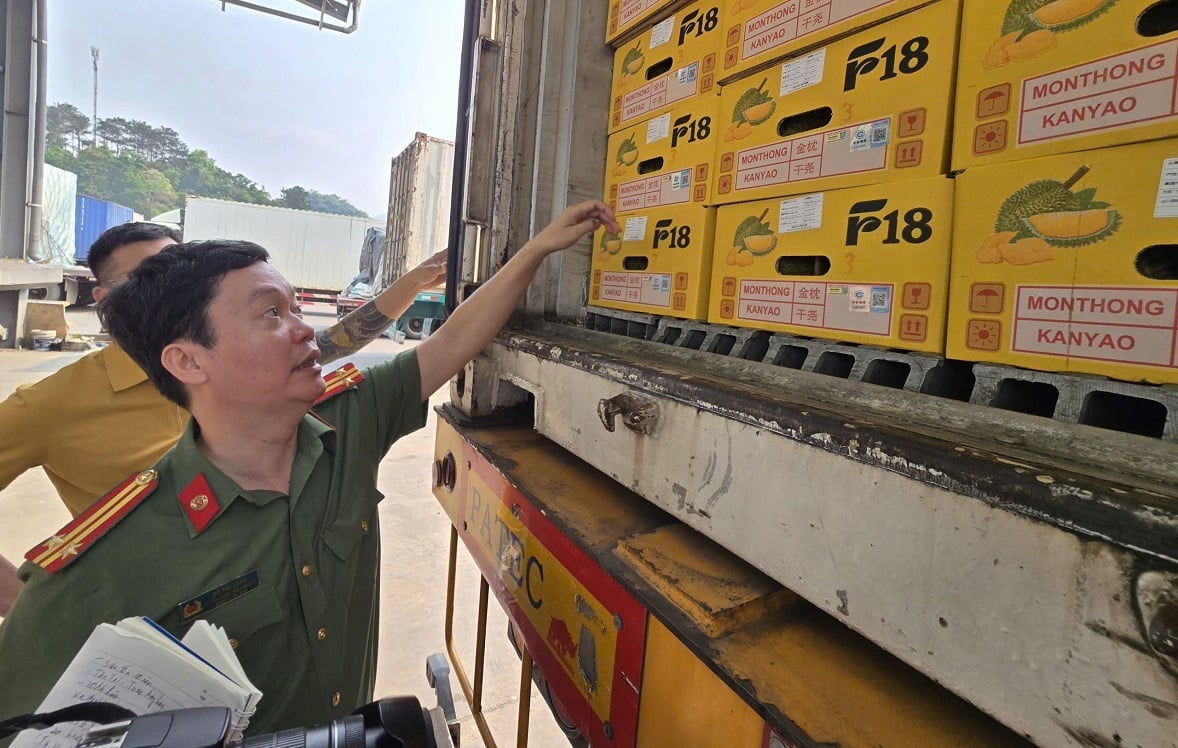
Each durian is assigned a unique QR code, enabling full traceability of its entire journey and ensuring product authenticity. Photo: Hoang Nghia.
Thanks to this, enterprises can clearly track every stage, from growth, care, and harvesting to distribution thereby improving product quality and meeting increasingly stringent market control requirements.
Data discipline in production
From an implementation perspective, it can be seen that the new approach is not only a technical change but also a transformation of the entire operational model.
According to Nguyen Ngoc Phu Qui, the enterprise plans to expand the use of this system for export shipments in the near future. Once operating stably, the process will enable better quality control and greater proactiveness in exports.
The company currently maintains export volumes of thousands of tons per year. Participation in this pilot program represents a transitional step toward adapting to new market requirements.
On the technical side, according to Lieutenant Colonel Do Phi Long, Director of the Center for Stamps and Anti-Counterfeit Materials (Ministry of Public Security), the stamping system, which uses a unique QR code for each product, enables full traceability of the product’s journey and ensures authenticity. This requires enterprises to strengthen discipline in production organization to ensure accurate data from the outset.
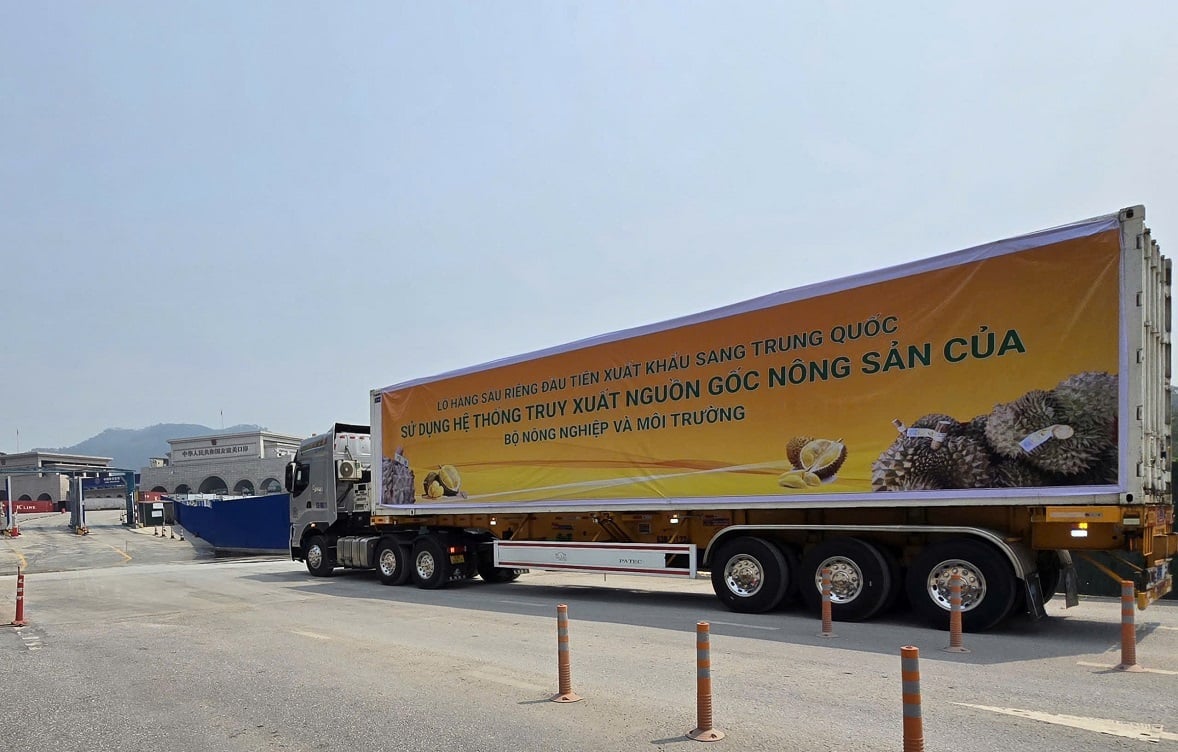
After completing customs procedures, the shipment continues its journey to the Chinese market under the new management process. Photo: Hoang Nghia.
From this reality, it is clear that enterprises will be the decisive factor in determining whether the new approach is implemented effectively in practice. If they proactively adapt, this will be an opportunity to enhance product value; conversely, if they are slow to change, the risk of losing market access is real.
April 10, 2026 marked an important milestone when the first durian shipment was exported under the ” green lane” mechanism through the Huu Nghi International Border Gate to China, reducing the time from harvest to customs clearance to just six days. Under the traditional method, this process typically took 8 to 11 days or longer. This improvement helps ease pressure on inspection procedures at border gates and reduces the risk of cargo congestion. Ministry of Agriculture and Environment issued Decision No. 5272/QD-BNNMT on December 13, 2025, aiming to develop a transparent, digitalized, and full-chain controlled agricultural management model.
Agriculture News | Agri Products Price