

Despite reducing emissions, improving the value of agricultural products, ecological agriculture in Vietnam is still difficult to expand because of lack of links, resources and synchronous policies, according to experts.
At the seminar to promote ecological agriculture by the Ministry of Agriculture and Environment, the International Nature Conservation Organization (WWF), the United Nations Food and Agriculture Organization (FAO) and the People’s Committee of Dong Thap Province on the afternoon of October 6, experts believe that the development of ecological agriculture is an indispensable path to adapt to climate change, but it needs long -term strategies and firm resources to spread.
Mr. Bui Hoai Nam, Institute of Agricultural Planning and Design, said that in the period of 2010–2025, the whole country had 275 ecological agricultural models, of which 60% made in the last 5 years, when Vietnam committed to net emissions in 0 in 2050. More than 60% of the projects using ODA capital, while domestic and private strength projects are still modest.
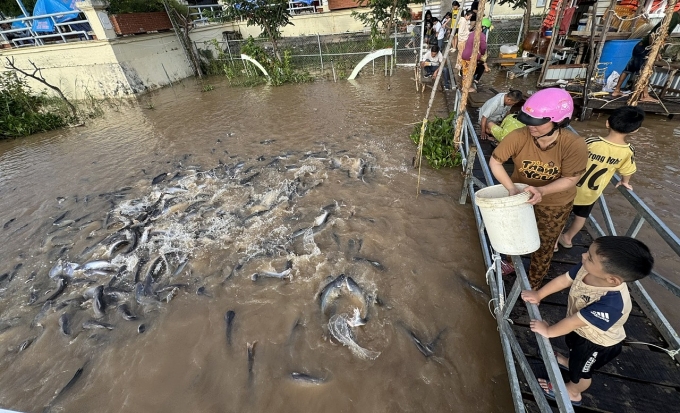
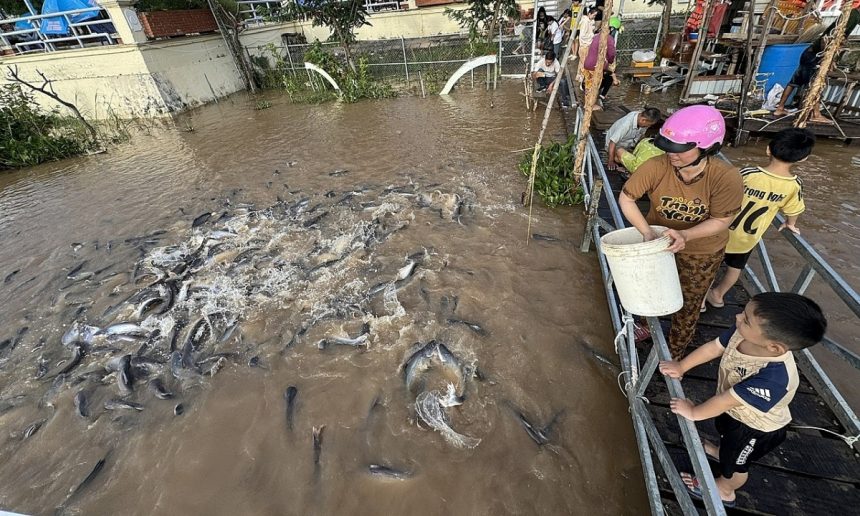
Fish conservation model in Hong Ngu ward, Dong Thap province. Image: Ngoc Tai
According to Mr. Nam, the models show discrete, small scale, and low efficiency. Many places have built policy infrastructure but the technical foundation at the farm is weak, degenerative soil, impaired water source, limited logistics, post -harvest post -harvest losses.
“The transformation of ecological agriculture is discrete, lacking synchronously and fractures from the central to local levels, while the capacity and thin resources make the models fall into the pilot trap, difficult to replicate,” Mr. Nam said.
Mr. Christopher Howe, Management of the Asia-Pacific Delta Initiative program, WWF-International, said that ecological agriculture should be considered a “recovery agriculture”, because it helps to rebuild the landscape and turn agriculture into a “social and ecological shelter” for humans and biodiversity.
Assoc.
Regarding the market, Mr. Vinod Ahuja, Chief Representative of FAO in Vietnam, said the demand for global ecological agricultural products is very large, estimated at $ 30 billion per year, but consumers are increasingly strict in food safety and ecological impact. “This is an opportunity, but it is necessary to invest practically in the whole chain – from production, traceability, product promotion to consumer approach,” he said.
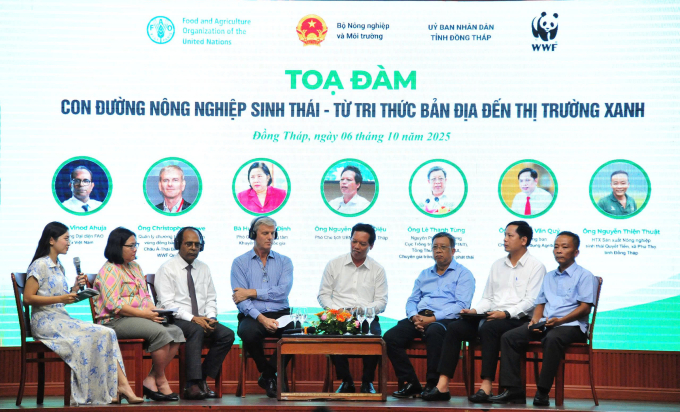
Representatives of international organizations, experts of the Ministry, localities and cooperatives at the seminar at the end of the seminar. Image: Ngoc Tai
Agreeing with Mr. Nam’s viewpoint, Mr. Huynh Quoc Tinh, Director of WWF-Vietnam Sustainable Agricultural and Food Program, said: “Why are the pilot models that are assessed successfully, profit, reduce costs but cannot replicate?”. He said that “it is necessary to look at the practical perspective, clearly identify the business model, maintain costs, who benefit” to create a motivation for sustainable development.
At the seminar, experts propose many solutions to promote the replication of eco -agriculture model, which emphasizes the completion of the legal framework, promulgates policies to encourage conversion such as tax incentives, financial support, technical training, extension of the agricultural extension network, along with branding and solving market barriers.
The agreement that ecological agriculture brings economic, social and environmental benefits, but to spread the companionship of the State, businesses and people, and a long -term strategy instead of short -term test models.
Ngoc Tai