




(VAN) Rubber prices on May 14 recorded a strong upward trend in global rubber prices, especially on the Shanghai Futures Exchange (SHFE).
Rubber prices on May 14 globally
On the global market, rubber prices moved higher, with rubber futures on the Shanghai Futures Exchange (SHFE) rebounding strongly.
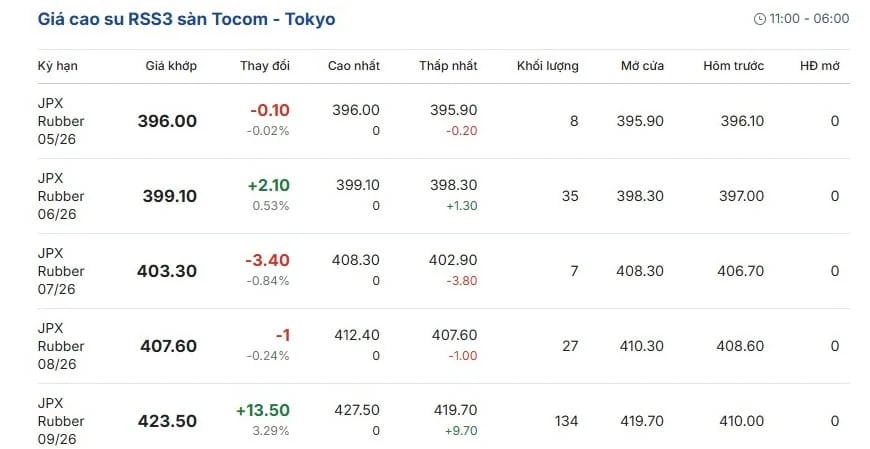
In the international market, rubber futures in Japan remained mostly flat across key contracts. Specifically, the May 2026 contract held steady at JPY 396/kg, the June 2026 contract remained unchanged at JPY 399.10/kg, and the July 2026 contract remained at JPY 403.30/kg.
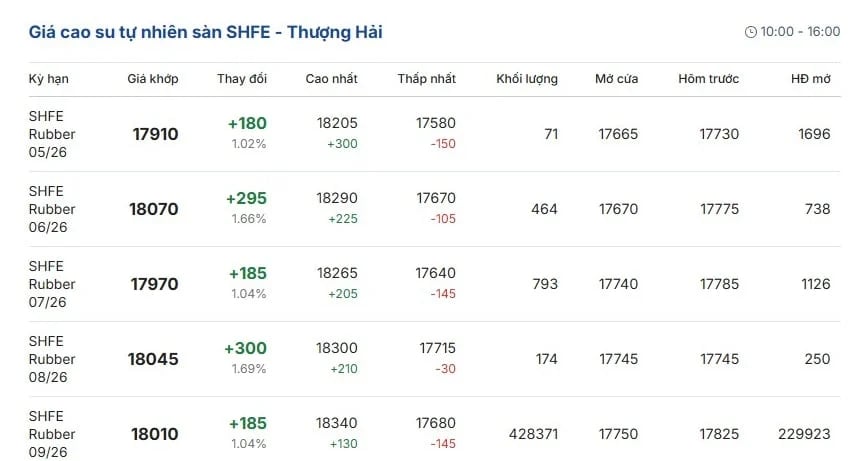
Meanwhile, on the Shanghai Futures Exchange, rubber prices rebounded sharply across multiple contracts. The May 2026 contract increased by RMB 180/ton (+1.02%) to RMB 17,910/ton; the June 2026 contract rose by RMB 295/ton (+1.66%) to RMB 18,070/ton; and the July 2026 contract gained RMB 185/ton (+1.04%) to RMB 17,970/ton. However, the August 2026 contract fell by RMB 300/ton, though it was still quoted at RMB 18,045/ton.
The June butadiene rubber contract, the most actively traded synthetic rubber product on the SHFE, also declined by RMB 50/ton, or 0.32%, to RMB 15,455/ton.
On the Osaka Exchange (OSE), the October 2026 rubber contract fell by JPY 0.5, equivalent to 0.12%, to JPY 413.1/kg (around USD 2.63/kg).
According to Reuters, Asian rubber markets broadly recovered during Wednesday’s trading session as selling pressure weakened and concerns over supply shortages in Thailand intensified due to adverse weather conditions.
The June butadiene rubber contract, the most actively traded contract on SHFE, also rose by RMB 335/ton, equivalent to 2.15%, to RMB 15,925/ton.
The main factor supporting prices came from concerns over tighter supply in Thailand, the world’s largest natural rubber producer. Thailand’s meteorological agency has forecast prolonged heavy rainfall next week and warned of flash floods and flooding risks in southern regions between May 16 and 18, where most of the country’s rubber plantations are located. Poor weather conditions could disrupt latex harvesting activities.
On the SICOM Singapore exchange, the June rubber contract traded at 230.1 U.S. cents/kg, up 3.7%.

Global rubber prices today recorded rebounds in both Japanese and Chinese rubber markets.
In Malaysia, natural rubber production in March fell by 8.2% from the previous month to 21,310 tons, down from 22,124 tons in February, according to data released Wednesday by Malaysia’s Department of Statistics.
Compared to the same period last year, production dropped sharply by 29.3% from 28,739 tons. The country’s total natural rubber inventories also declined by 1.8% to 139,174 tons in March, compared to 141,697 tons in the previous month.
On the other hand, Malaysia’s rubber exports fell by 2.2% to 33,137 tons from 33,897 tons recorded in the previous month.
Thus, global rubber prices on May 14, 2026 mainly recorded upward movements across trading exchanges.
Rubber prices on May 14 domestically
Domestically, at Binh Long Rubber Company, rubber purchasing prices all increased by VND 70 per TSC degree/kg. Factory purchasing prices rose to VND 505/TSC/kg, while purchasing prices at production teams reached VND 495/TSC/kg. Meanwhile, mixed latex prices (DRC 60%) increased by VND 4,000 to VND 18,000/kg.
Meanwhile, other companies kept prices stable. At Mang Yang Rubber Company, fresh latex purchasing prices remained around VND 458-463/TSC (grade 2-grade 1), while mixed coagulated latex prices stayed around VND 404-459/DRC (grade 2-grade 1).
Ba Ria Rubber Company also maintained fresh latex purchasing prices at VND 420/TSC/kg (applicable for TSC levels from 25 to under 30), with coagulated latex DRC (35–44%) priced at VND 14,600/kg and raw latex at VND 18,100/kg.
Phu Rieng Rubber Company continued quoting fresh latex purchasing prices at VND 420/TSC, while mixed latex prices remained unchanged at VND 390/DRC.
$ 1 = VND 26,382 – Source: Vietcombank.
Agriculture News | Agri Products Price