

(VAN) Buoyed by positive market signals, many fruit companies are accelerating raw material zone linkages, raising production standards, and preparing for a new phase of competition.
Riding the wave of a billion-consumer market
Exporting eight to ten containers of dragon fruit to China and multiple Asian markets every week, Vo Huy Hoang, Director of Hoang Tho Fruit Company, said customers are continuously inquiring about Vietnam’s green-skinned pomelo.
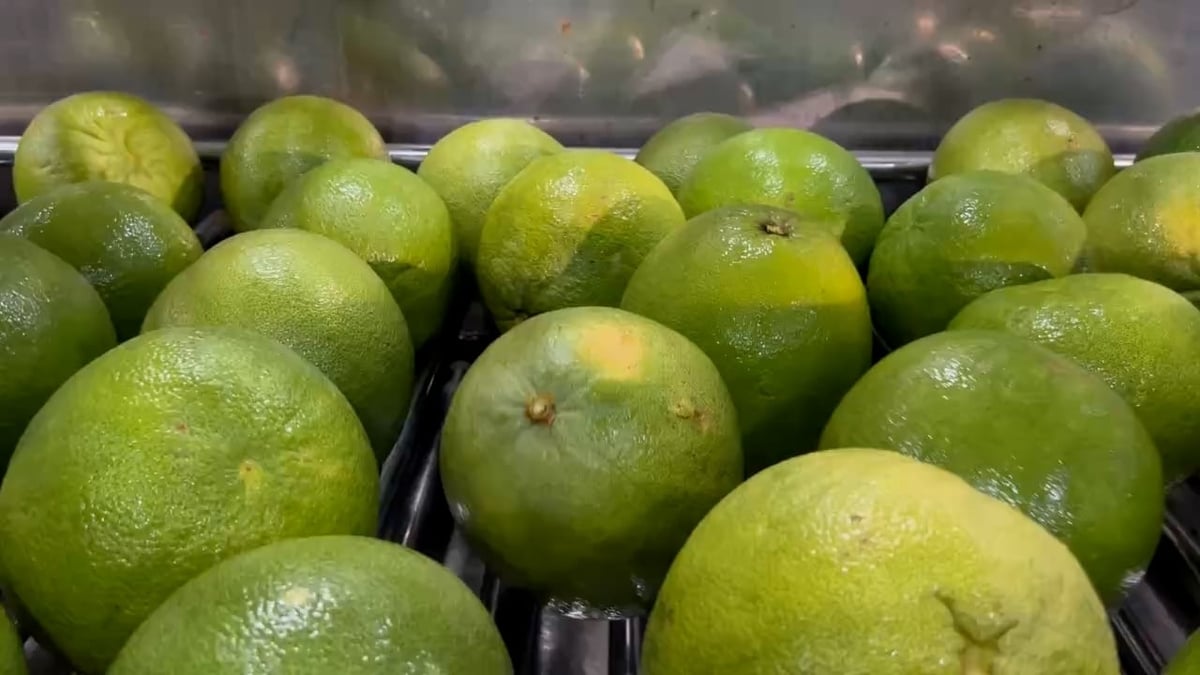
Vietnamese green-skinned pomelo is assessed by many companies as having significant room for growth in the Chinese market. Photo: Ha Linh.
According to Hoang, Chinese market demand for Vietnamese pomelo and lime is very large, particularly for the green-skinned pomelo variety. Beyond strong consumption volumes, this group of fruits is used on a daily basis, meaning purchasing power is considered far more stable than that of seasonal fruit varieties.
To seize the market opportunity, the company has connected with multiple cooperatives in Dong Thap and Vinh Long provinces to prepare raw material zones for export. “When I heard the news that the market was opening, I went straight to Ho Chi Minh City to learn about the implementation process. My customers require that goods be delivered to them immediately once available,” Hoang said.
Similarly, Ngo Tuong Vy, General Director of Chanh Thu Group, said the company has surveyed the Chinese market for many years and identified significant room for Vietnamese pomelo to enter the country’s retail system.
According to Vy, although China also grows many pomelo varieties, Vietnamese green-skinned pomelo is highly regarded for its distinctive flavor. The company has worked directly with supermarket chains in China to prepare for export plans once growing zones meet technical requirements.
“The important thing is to create products that precisely meet market demand. If done properly, this will become a stable outlet that gives farmers the confidence to invest and improve their growing zones,” Vy said.
From the perspective of the industry association, Dang Phuc Nguyen, Secretary General of the Vietnam Fruit and Vegetable Association, assessed that the additional market opening for pomelo and lime will create further growth room for fruit and vegetable exports at a time when many major markets are tightening technical standards.
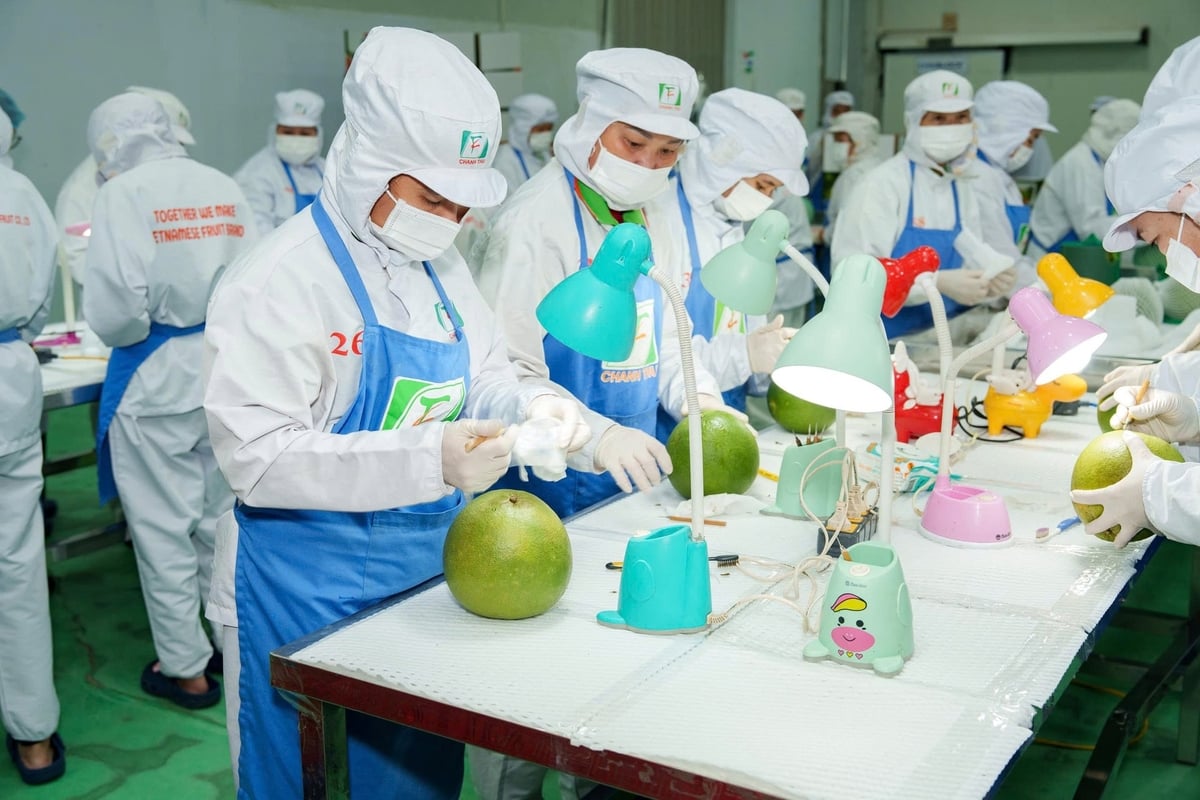
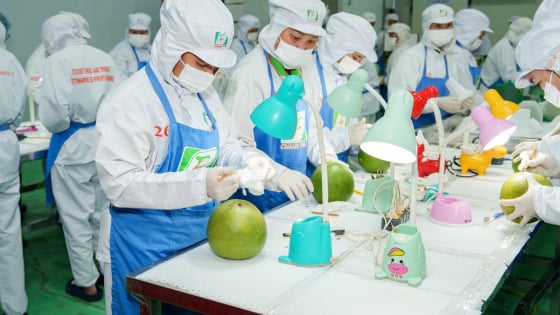
Workers processing and grading pomelo at a packaging facility for export. Photo: Viet Huong.
According to Nguyen, China is a very large consuming market for citrus fruit. Despite direct competition with Chinese domestic produce and multiple other countries including Thailand, Egypt, and Turkey, Vietnamese fruit still holds advantages in flavor and logistics costs.
“The important point is to organize production in alignment with seasons, avoiding direct competition with China’s own harvest period. If off-season production is managed well and quality is kept consistently under control, Vietnamese pomelo and lime still have the capacity to expand market share,” Nguyen assessed.
Raising growing zone standards
Alongside the opportunity to expand exports, the official market opening for pomelo and lime to China also places higher demands on production organization. Where previously many growing zones primarily sold through traders or in small export volumes, those seeking to compete over the long term must now shift toward more systematic approaches.
Hoang Trung, Deputy Minister of Agriculture and Environment, said the industry’s current orientation is no longer to chase volume but to focus on quality improvement, food safety assurance, and full compliance with the technical standards of importing markets.
According to the Deputy Minister, the signing of the new protocol is only the first step. More importantly, production must be reorganized comprehensively, from raw material zones, growing area codes, and packaging facilities through to pest control and traceability.
“For sustainable export, growing area codes must be well managed, pest control must be in place, farming records kept, and pesticide residues controlled. These are mandatory conditions for Vietnamese fruit to go further,” the Deputy Minister emphasized.
Going beyond technical requirements, many export companies are also beginning to shift strongly toward green production models to adapt to new global consumption trends.
Nguyen Dinh Tung, Chairman of the Board of Directors of Vina T&T Group, said the company has been gradually transitioning to renewable energy use and electric vehicles, and is requiring supply chain partners to join in reducing emissions.
According to Tung, importing markets today are not only concerned with fruit quality but also pay close attention to environmental standards, carbon emissions, and the sustainability of the production chain. Raising growing zone standards, building traceability systems, and developing green agriculture will therefore become an inevitable direction if Vietnamese fruit is to strengthen its competitiveness in the period ahead.
Agriculture News | Agri Products Price