

(VAN) By guaranteeing purchase contracts and stable prices, Thieu Vien Agricultural Services Cooperative has become an indispensable partner for local farmers to build a high-quality rice production zone anchored in sustainable value chains.
A solid foundation for farmers
Harvest season arrives at the Thieu Vien fields of Thieu Trung commune in Thanh Hoa province, carried on the warm scent of fresh straw and the early-morning hum of combine harvesters. Golden paddies stretch in even, ruler-straight rows across the plain. Along the field embankments, farmers watch a convoy of rice-laden trucks rolling steadily toward the yard of Thieu Vien Agricultural Services Cooperative, their faces visibly lighter, their eyes lit with a quiet, unmistakable relief.
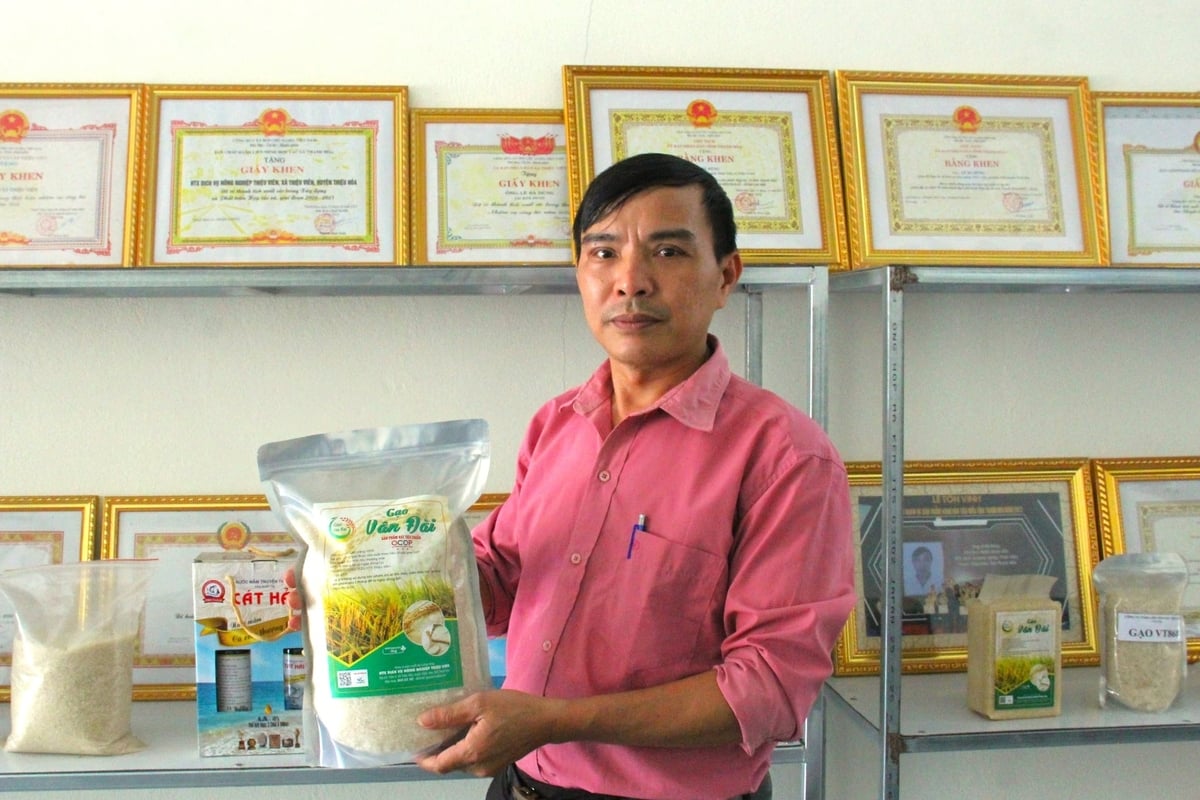
According to Le Ba Dung, a cooperative can only rally farmers to its cause by keeping its word. Photo: Phi Yen.
In many rural areas across Vietnam, the greatest anxiety for rice farmers remains finding a buyer. At peak harvest, prices can fall by the day, leaving growers entirely at the mercy of itinerant traders. In Thieu Vien, the cooperative has been steadily changing that reality.
Le Ba Dung, Director of Thieu Vien Cooperative, recounted that the organization was founded in 1998. As agricultural production came under growing market pressure, the cooperative proactively reinvented itself, beginning with small-scale linkage models. Today it has developed more than 200 hectares of rice cultivated under integrated value chain arrangements, covering varieties including Thai Xuyen, fragrant sticky rice, and J02.
What sets the model apart is that the cooperative’s involvement does not stop at guaranteed purchase. Thieu Vien participates in virtually the entire production cycle, supplying seeds, fertilizers, and irrigation, providing seedling trays, transplanting machines, and technical training, and overseeing both the harvest and the sale of output. Across its linked fields, rice is sown and transplanted on a unified schedule. Machinery has progressively replaced manual labor, and cultivation practices are subject to rigorous oversight.
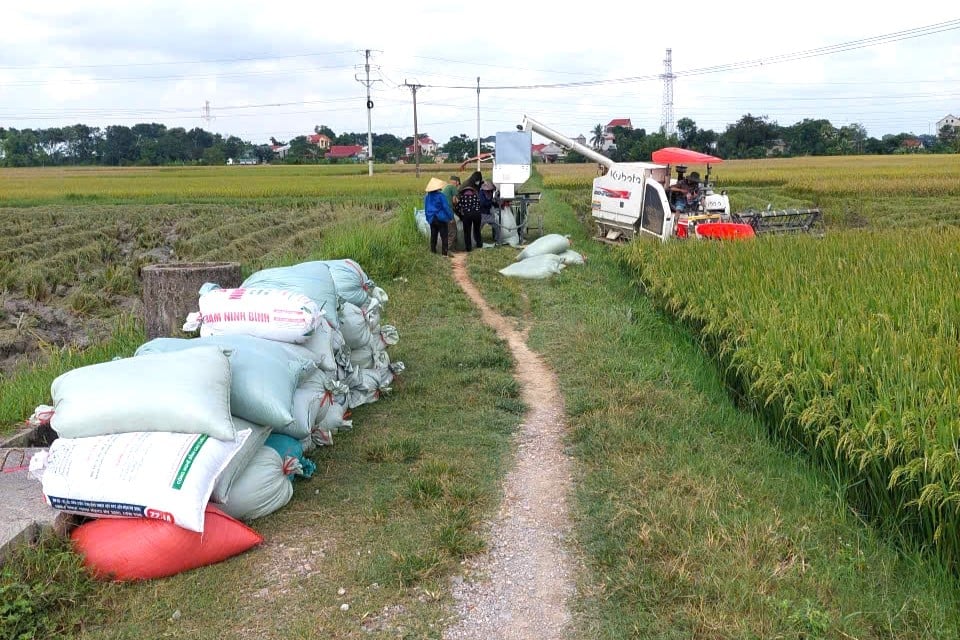
Thieu Vien Cooperative serves as a one-stop coordinator for farmers, supplying seeds, fertilizers, and irrigation, providing seedling trays and transplanting machinery, delivering technical training, and managing both the harvest and guaranteed product purchase. Photo: Phi Yen.
Dung acknowledged that the hardest part of building large consolidated fields is not technical but human. Farmers accustomed to working independently must be persuaded to plant the same variety, follow the same seasonal calendar, and adhere to a shared production protocol, and that, he said, is a long conversation.
One episode remains fixed in his memory: the spring crop of 2022, one of the most difficult seasons he has ever navigated. Prolonged heavy rains caused roughly 50 hectares of contracted rice to sprout on the stalk before harvest. Quality fell sharply, and the grain no longer met the standards required under the cooperative’s purchase agreements with its corporate partners.
Rather than leaving farmers to fend for themselves, the cooperative sat down with its partners to find a solution. After extensive negotiations, it drew more than 160 million dong from its risk reserve fund, using the money jointly with the enterprise to subsidize prices and purchase the entire affected output. The cooperative also advised local authorities to reduce land lease fees for the most severely affected plots.
“Running a cooperative means keeping faith with farmers,” Dung said plainly. “If you walk away when things get hard, who will trust you enough to partner with you the next season?”
That approach has earned the cooperative deep loyalty in Thieu Vien. Farmers have adopted unified production protocols, shared planting schedules, and common varieties to build a large, consistent raw-material zone. The trust they place in the cooperative did not come from slogans on a wall; it came from watching their own fields deliver tangible, lasting benefits.
To manage operations effectively, cooperative staff spend most of each growing season out in the fields rather than at their desks. Service teams have been established in each village, with hamlet leaders serving as production cell heads who coordinate directly with the cooperative to monitor planting schedules, manage pest and disease control, and encourage farmers to comply with shared protocols.
The durability of these linkages has deepened farmers’ commitment to the model. Rice products are now produced to consistent, high standards. The cooperative has established two VietGAP-certified production zones: a 25-hectare Van Dai rice zone and a 10-hectare Vien Noi rice zone.
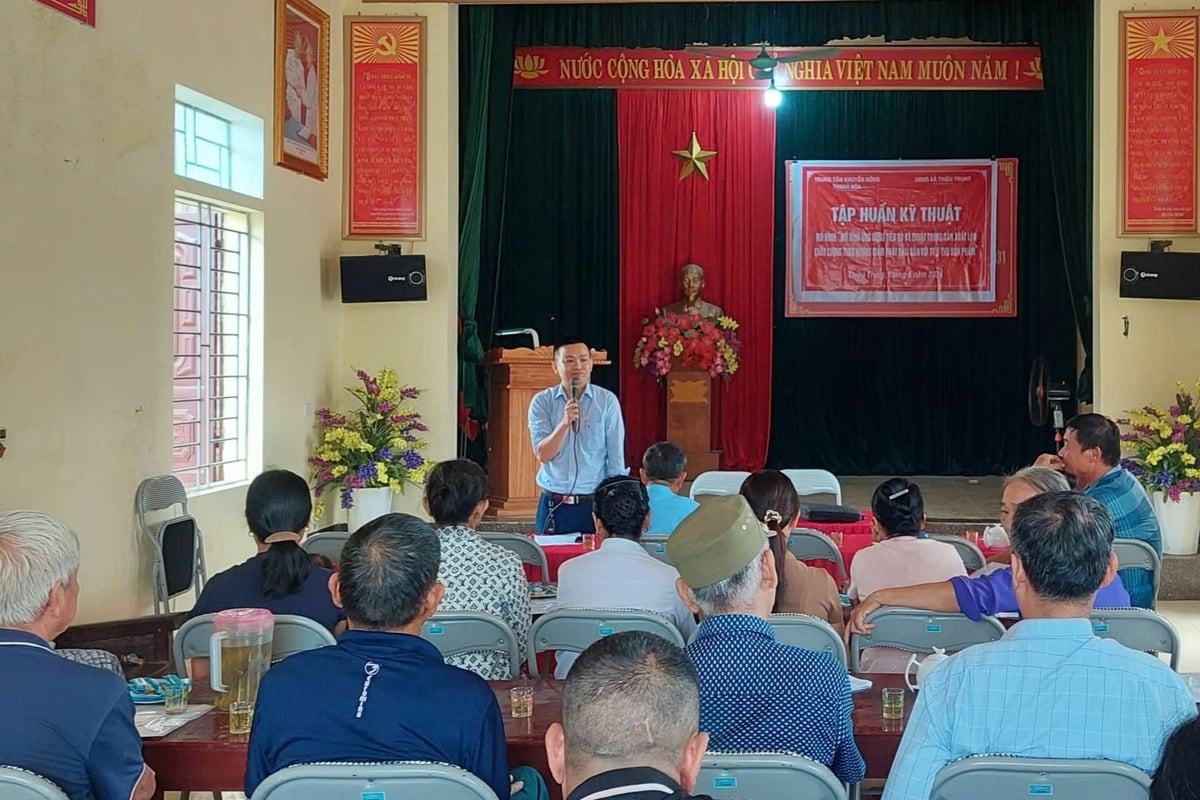
Thieu Vien Cooperative regularly collaborates with the provincial agricultural extension center and partner enterprises to organize technical training sessions and transfer advanced technologies to farmers. Photo: Thieu Vien Cooperative.
Van Dai rice earned a three-star OCOP certification in 2023, enabling it to command a stable retail price of around 20,000 to 21,000 dong per kilogram. Vien Noi rice sells at an average of 15,000 to 16,000 dong per kilogram. Crucially, cooperative rice is no longer sold as anonymous country grain. Each bag carries a traceability stamp, a QR code, and information about the growing region and production process, credentials that have opened doors with major corporate buyers.
Keeping farmers on the land
What weighs most heavily on Dung and the cooperative’s board is not output volume but the more fundamental question of how to keep people willing to farm. Accordingly, the cooperative has set its sights beyond basic service provision, aiming instead to build a sustainable production linkage chain that delivers stable, worthwhile income to its members.
In recent years, the cooperative has run a continuous series of technical training sessions, working with enterprises, research institutes, and the provincial agricultural extension center to transfer new technologies to farmers. Many members have also been helped to access credit for production investment.
In line with Thieu Trung commune’s development plan for 2025 to 2030, the locality aims to develop 200 hectares of high-yield, high-quality rice production incorporating modern technology. Thieu Vien Cooperative has committed to delivering 70 of those hectares. The target represents more than a land area figure, it reflects an ambition to fundamentally transform the way farming is practiced in a traditionally agrarian community. The cooperative also plans to construct more than 6,000 square meters of greenhouse and net-house facilities to support high-technology agricultural production.
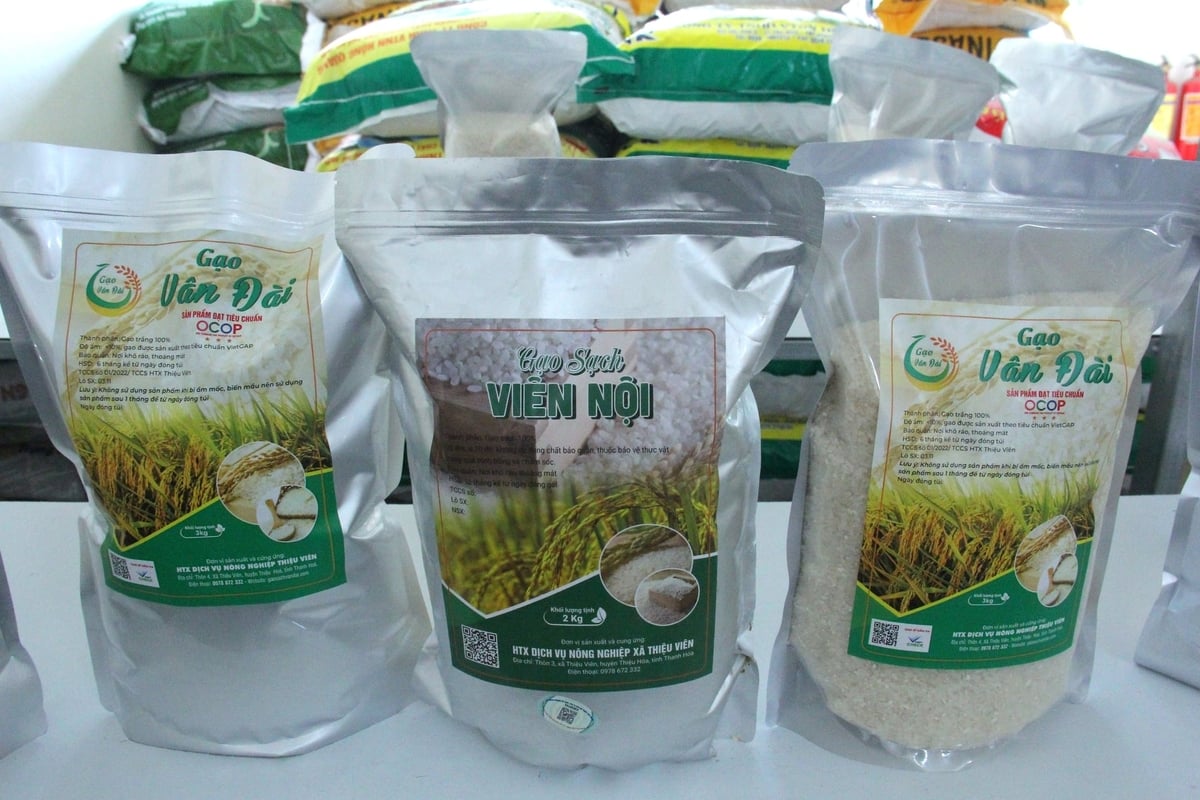
Thieu Vien Cooperative has established two VietGAP-certified rice production zones, producing Van Dai rice and Vien Noi rice. Photo: Phi Yen.
These efforts have established Thieu Vien Agricultural Services Cooperative as one of Thanh Hoa province’s most exemplary cooperative models. In 2026, it received the CoopStar Award from the Vietnam Cooperative Alliance. It has previously received numerous emulation flags and commendations for its contributions to agricultural development and value chain building.
But for Dung, the most meaningful reward is simpler than any trophy. It is the fact that farmers still want to hold onto their land as a long-term livelihood rather than leave it behind to seek work elsewhere. Fields that were once fragmented and scattered have been consolidated into large, coherent production zones. Each harvest season, farmers no longer stand at the edge of their paddies dreading a price collapse.
In Thieu Vien today, the familiar scene of traders haggling at the field’s edge, shortchanging weights, talking down quality, and forcing prices down at the height of the harvest rush, has largely disappeared. Behind the farmers now stands the cooperative, acting as their guarantor. Purchase prices are consistently set a few notches above the open market, and there is no short-weighing of the kind traders routinely practice. Dung put it with a wry smile: “Traders who want to come in and buy rice here find it pretty difficult, because once the cooperative has offered that price, there is almost no margin left for them to squeeze the
Agriculture News | Agri Products Price