




(VAN) Rubber prices on June 15, 2026, recorded mixed movements across major global exchanges, while domestic natural rubber purchasing prices remained stable.
Rubber prices on June 15 globally
Global rubber prices remained stable among major domestic enterprises, while the global market ended the trading week with mixed movements.
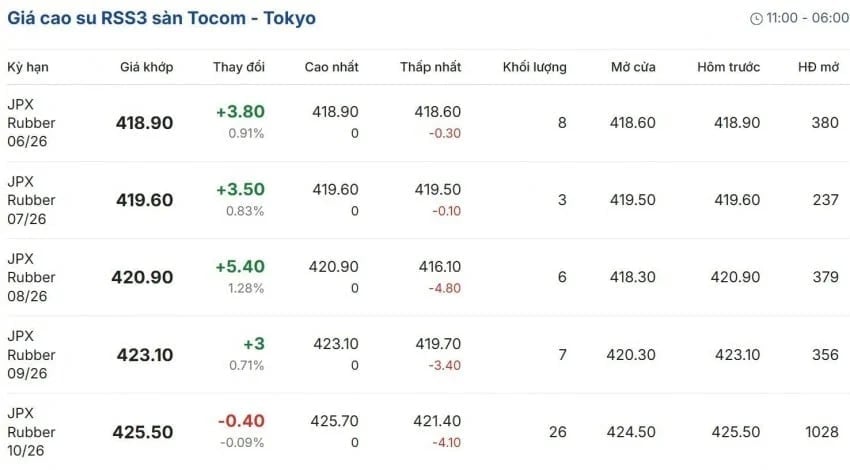
On the Tokyo Tocom exchange, RSS3 rubber prices continued to move unevenly across contracts but generally followed an upward trend. Specifically, the June 2026 contract rose by 3.80 yen/kg (+0.91%) to 418.90 yen/kg; the July 2026 contract increased by 3.50 yen/kg (+0.83%) to 419.60 yen/kg; while the October 2026 contract edged down by 0.40 yen/kg (-0.09%) to 425.50 yen/kg.
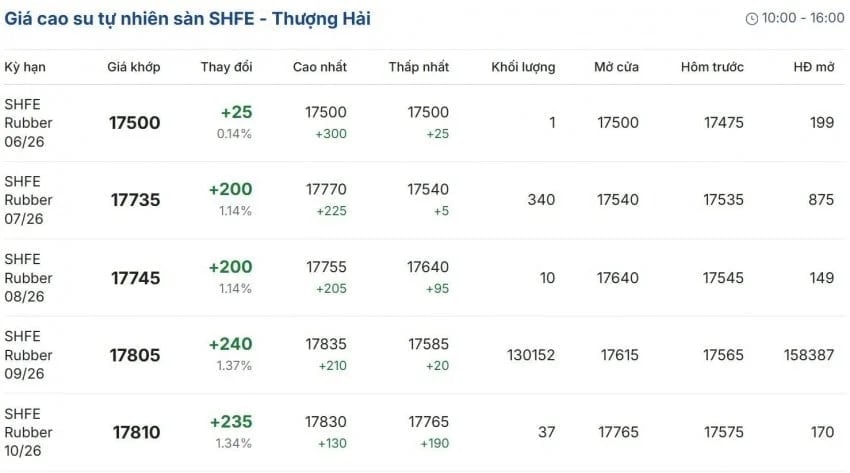
On the SHFE Shanghai exchange, natural rubber prices ended the week with slight gains across delivery contracts. The June 2026 contract rose by 25 yuan/ton (+0.14%) to 17,500 yuan/ton; the July 2026 contract increased by 200 yuan/ton (+1.14%) to 17,735 yuan/ton; and the August 2026 contract gained 200 yuan/ton (+1.14%) to 17,745 yuan/ton.
Rubber prices ended the trading week in mixed directions, affected by both energy price movements and supply concerns. On the Osaka Exchange, the November rubber contract fell 0.65% in the final session of the week to 426.1 yen/kg. For the week as a whole, the contract lost 0.81%, reflecting investor caution amid crude oil price adjustments, which are closely linked to rubber due to competition with synthetic products.
The July butadiene rubber contract, the most actively traded synthetic rubber product on SHFE, also rose by 140 yuan, or 1.06%, to 13,370 yuan/ton.
In addition, Thailand’s export RSS3 rubber rose nearly 2% to 104.02 baht/kg, while the SICOM Singapore contract also edged up 0.5%, as the market gradually priced in regional supply shortage risks.
On SICOM Singapore, the July rubber contract also increased by 0.5% to 225.5 US cents/kg.
Analysts said the rubber market is being supported by concerns over supply in the second half of the year. In addition, raw material demand from Asia’s tire manufacturing industry remains stable, helping support rubber prices despite pressure from lower global oil prices.
Analysts noted that natural rubber prices often move in line with oil prices because natural rubber competes with synthetic rubber, which is produced from petroleum-based raw materials.

Global rubber prices opened the session in positive territory, supported by a combination of macroeconomic and geopolitical factors. On the Singapore Exchange, the July rubber contract was recorded at 224.2 US cents/kg, up 0.7%.
In the currency market, the Japanese yen continued to weaken, with the exchange rate around 160.52 JPY/USD. This tends to support yen-denominated assets while improving the competitiveness of Japanese exports.
However, fundamental factors still do not fully support a sustainable upward trend. Rubber demand is entering its seasonal low period, while automobile sales in China, the world’s largest consumer market, remain weak, continuing to pressure demand prospects.
Weather has become the most notable variable in the market. According to Thailand’s Meteorological Department, from June 12–17, many key production areas in Thailand, Myanmar, Laos, and northern Vietnam may experience prolonged heavy rainfall. These regions play important roles in the global natural rubber supply chain, raising concerns over short-term production disruptions.
Adverse weather not only affects tapping output but also reduces the number of tapping days, complicates collection and transportation, and weakens raw material quality. Processing factories also face risks of production delays due to high humidity.
Thus, global rubber prices on June 15, 2026, recorded an upward trend across trading exchanges.
Rubber prices on June 15 domestically
In Vietnam, latex purchasing prices remained unchanged from yesterday. At Binh Long Rubber Company, factory purchasing prices stayed at VND 505/TSC degree/kg, while purchasing prices at production teams remained at VND 495/TSC degree/kg. Scrap latex (DRC 60%) increased by VND 4,000 to VND 18,000/kg.
Other enterprises also maintained stable prices. At MangYang Company, fresh latex purchasing prices ranged from VND 458-463/TSC (grade 2-grade 1), while coagulated latex ranged from VND 404–459/DRC (grade 2-grade 1).
Ba Ria Rubber Company quoted fresh latex purchasing prices at VND 420/TSC degree/kg, applicable for TSC levels from 25 to under 30. DRC latex at 35-44% stood at VND 14,600/kg, while raw latex was priced at VND 18,100/kg.
Phu Rieng Rubber Company continued to quote fresh latex at VND 420/TSC, while scrap latex remained at VND 390/DRC.
$ 1 = VND 26,423 – Source: Vietcombank.
Agriculture News | Agri Products Price