




(VAN) Rubber prices on June 22 recorded mixed movements across major global exchanges, while domestic latex purchasing prices remained stable.
Rubber prices on June 22 globally
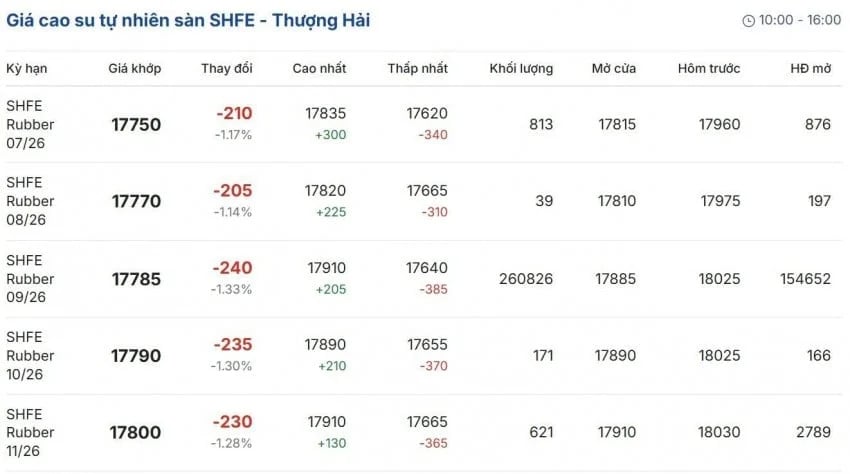
In the global market, rubber prices experienced sharp fluctuations across Asian futures exchanges. On the Shanghai Futures Exchange (SHFE), rubber prices fell by more than 1% in the final trading session of the week, pushing contracts close to CNY 17,750/ton as global crude oil prices weakened amid easing tensions around the Strait of Hormuz.
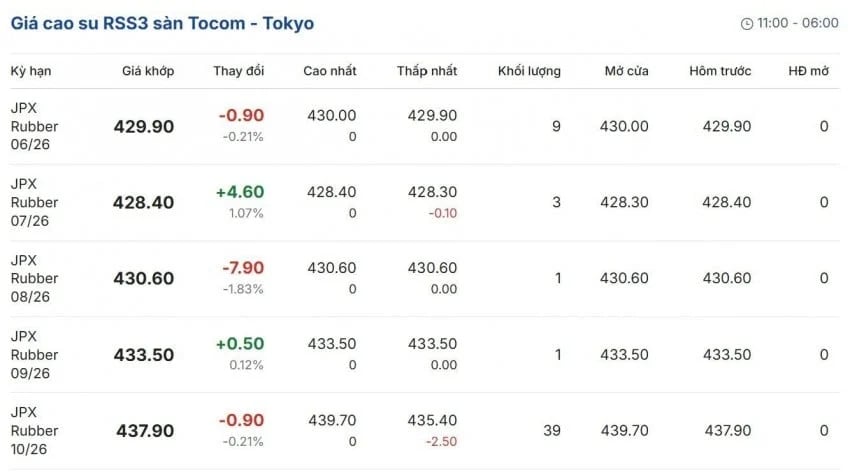
On the TOCOM Tokyo exchange, RSS3 rubber futures moved in mixed directions across contract months. Specifically, the June 2026 contract fell by JPY 0.90/kg (-0.21%) to JPY 429.90/kg; the July 2026 contract rose by JPY 4.60/kg (+1.07%) to JPY 428.40/kg; while the August 2026 contract declined by JPY 7.90/kg (-1.83%) to JPY 430.60/kg.
On the SHFE, natural rubber futures extended their losses across major delivery months. The July 2026 contract dropped CNY 210/ton (-1.17%) to CNY 17,750/ton; the August 2026 contract fell CNY 205/ton (-1.14%) to CNY 17,770/ton; and the September 2026 contract declined CNY 240/ton (-1.33%) to CNY 17,785/ton.
Asian rubber markets are facing multiple headwinds as weaker oil prices and growing concerns over potential currency intervention by the Japanese government weigh on investor sentiment.
On the Singapore Exchange (SGX), the July rubber contract fell 0.3% to 226.7 US cents/kg. The move reflects investor caution amid changing global economic and geopolitical conditions.
One of the main factors pressuring rubber prices is the decline in global oil prices. Energy markets have cooled as shipping activity through the Strait of Hormuz gradually returns to normal and tensions between the United States and Iran show signs of easing. Lower oil prices typically reduce the competitiveness advantage of natural rubber over petroleum-based synthetic rubber.
In addition, the Japanese yen has weakened to its lowest level since July 2024, raising concerns that Japan may once again intervene in the foreign exchange market. Earlier, Tokyo spent approximately JPY 11.7 trillion ($72.54 billion) to support its currency during late April and early May.
Despite the late-week decline, TOCOM has retained most of the gains accumulated over recent weeks, indicating that market sentiment has not yet turned decisively negative.

Rubber prices today, June 22, 2026: Mixed movements.
Global rubber prices continued to show mixed performance today as currency movements, risk sentiment, and demand expectations exerted conflicting influences on the market.
Analysts noted that reduced market liquidity during the U.S. Juneteenth holiday could increase the risk of sharp foreign-exchange fluctuations. This may directly affect short-term rubber price movements, making it difficult for the market to sustain the strong rally seen recently.
Price action on SGX was softer than on SHFE. After declining for two consecutive sessions earlier in the week, TSR20 contracts rebounded in the final trading session.
SGX’s quicker recovery compared with TOCOM also suggests that capital continues to favor contracts linked more closely to actual consumption demand.
In a related industry development, Malaysia’s Top Glove reported a 138% surge in third-quarter profit, driven by timely selling-price adjustments and effective cost controls amid rising raw-material costs, according to Reuters.
Net profit for the quarter ended May 31 reached RM 81 million (approximately $ 19.79 million), up significantly from RM 34.7 million a year earlier.
Third-quarter revenue also rose strongly to RM 1.09 billion, compared with RM 830.3 million in the same period last year.
Thus, global rubber prices on June 22, 2026, generally trended lower across major exchanges.
Rubber prices on June 22 domestically
In Vietnam, latex purchasing prices remained unchanged from the previous day.
At Binh Long Rubber Company, factory purchasing prices remained at VND 505 per TSC degree/kg, while collection-point purchases stayed at VND 495 per TSC degree/kg. Mixed latex (DRC 60%) remained at VND 18,000/kg.
Other major companies also kept prices stable. At MangYang Rubber Company, fresh latex was purchased at around VND 458-463/TSC (Grade 2-Grade 1), while coagulated latex was quoted at approximately VND 404-459/DRC.
Ba Ria Rubber Company maintained fresh latex purchasing prices at VND 420 per TSC degree/kg (for TSC levels from 25 to under 30), with DRC latex (35-44%) at VND 14,600/kg and raw latex at VND 18,100/kg.
Meanwhile, Phu Rieng Rubber Company continued to purchase fresh latex at VND 420/TSC, while mixed latex remained unchanged at VND 390/DRC.
$ 1 = VND 26,442 – Source: Vietcombank.
Agriculture News | Agri Products Price