

(VAN) For many businesses, exporting is a costly trial. But for those choosing a long-term path, small orders are a way to keep markets and learn the rules.
Small orders to learn standards
Mr. Le Anh, Director of Le Gia Food & Trading Services Co., Ltd., said it took the company nearly two years from the time Japanese partners visited and assessed the factory to receiving the first order. The initial order was small, with high testing and logistics costs, so financial calculations showed a loss. However, the company continued to do so, treating it as an investment to “buy” standards and maintain the partnership.
For many small and medium-sized agricultural enterprises, especially OCOP producers, exports typically begin with trial consignments rather than full containers. The immediate economic value may be modest, but the market value is clear: products are tested under real conditions by real buyers.

Mr. Le Anh, Director of Le Gia Food & Trading Services Co., Ltd. Photo: Tien Thanh.
According to Mr. Le Anh, small orders allow businesses to recognize the practical requirements of their target markets, from testing conditions and delivery procedures to ways to handle customer feedback. “If we start immediately with a large order, the risks are very high. Just one minor mistake can cause the entire market to close,” he said.
From a risk management perspective, small orders are viewed as a learning tool, with the costs considered tuition fees. Companies that pay this tuition early often gain an advantage when scaling up later.
One key difference in the approach of businesses that persist in exporting is their focus on retaining markets rather than chasing production volumes. Once an importer is secured, even for small, infrequent orders, businesses still prioritize maintaining consistent quality and delivering on commitments. This approach requires a high level of discipline. Companies must accept foregoing short-term profit optimization and instead prioritize investment in quality control systems and compliance with standards.
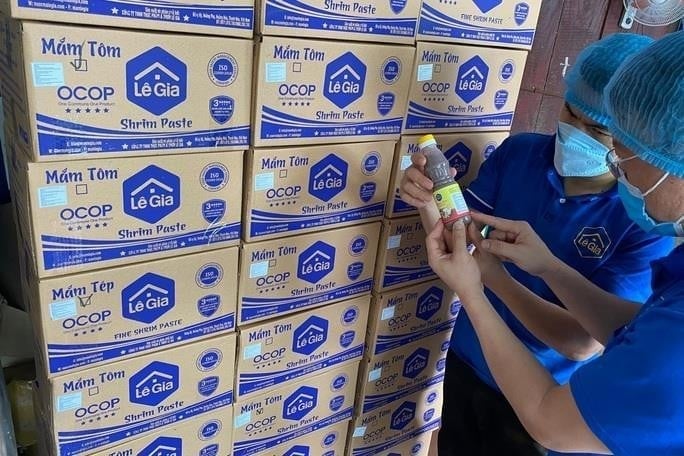
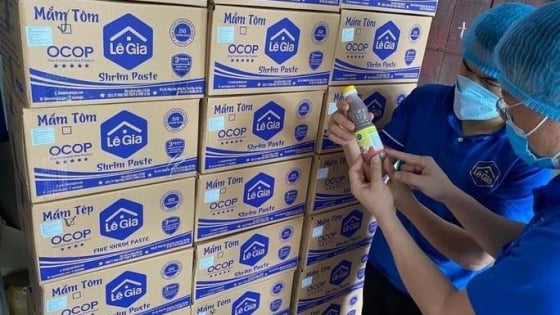
Le Gia fish sauce was among the earliest products nationwide to achieve a five-star OCOP rating. Photo: Hoang Thuy.
Strengthening the domestic market first
Another shared characteristic of companies with long-term export journeys is laying a solid foundation in the domestic market. For Le Gia Fish Sauce, a stable presence in the domestic retail system has helped the company establish initial credibility with foreign partners. Many importers study products by surveying the domestic market before deciding whether to cooperate.
Based on Mr. Le Anh’s experience, the domestic market is not only a source of revenue but also a “test” for processes and operational capacity. Companies that fail to control quality at home are unlikely to meet export requirements.
In addition to formal exports, many businesses use on-the-spot exports linked to tourism as a stepping stone. Although this channel does not generate significant revenue immediately, it allows companies to observe international consumers’ responses directly. The information gained is then used to adjust products before they enter official export channels.
From the story of Le Gia fish sauce, it is clear that there are no shortcuts in agricultural exports. Small orders, long timelines, and high costs are everyday realities. The difference lies in how companies view the early stage as a burden or as an investment.
For businesses that treat small orders as a tool to retain markets and learn standards, exporting becomes a process of accumulation. Once the market has accepted their products, scaling up tends to occur more naturally and with lower risk.
Agriculture News | Agri Products Price