



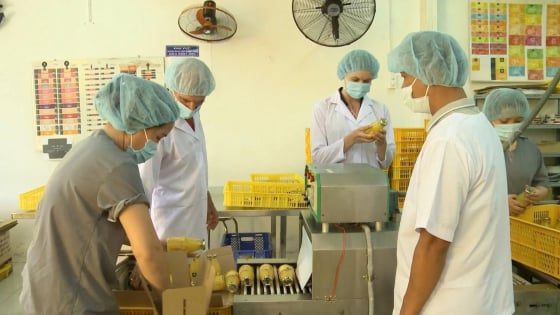
(VAN) Making up roughly two-thirds of total produce export value to the EU, processed items have become a major catalyst for maintaining strong market momentum.
Processed products drive export growth
Viet Nam’s fruit and vegetable exports to the European Union (EU) have maintained strong growth momentum. According to the Viet Nam Fruit and Vegetable Association, export turnover to the EU reached approximately USD 214.4 million in the first six months of 2026, up 31.8% compared to the same period in 2025.
In June 2026 alone, exports to the EU totaled USD 46.8 million, representing an increase of 9.8% from the previous month and 37.9% year-on-year. During the first half of 2026, the EU accounted for approximately 5.8% of Viet Nam’s total fruit and vegetable export value.
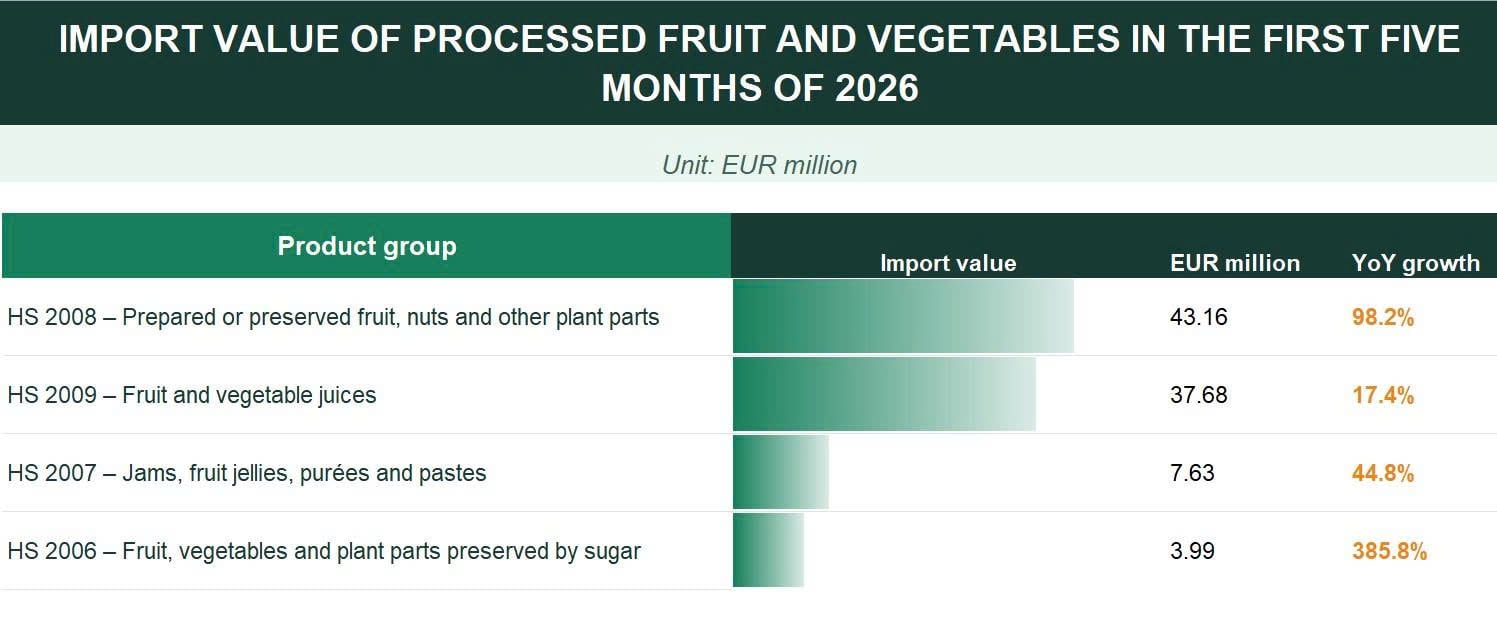
EU imports of processed fruit and vegetable products from Viet Nam increased during the first five months of 2026. Photo: Ha Duyen.
Although the EU remains a much smaller market than China in terms of export value, its robust growth indicates that it is emerging as one of the fastest-growing destinations for Vietnamese fruit and vegetables. Notably, this momentum is being driven not only by fresh produce but increasingly by processed products.
According to Dang Phuc Nguyen, Secretary General of the Viet Nam Fruit and Vegetable Association, processed products currently account for around two-thirds of Viet Nam’s fruit and vegetable exports to EU. This is significantly higher than the industry’s overall export structure, in which processed products represented 30.85% of total fruit and vegetable export turnover during the first half of 2026.
Preliminary statistics compiled by the Association from data provided by the Department of Viet Nam Customs show that exports of processed fruit and vegetable products reached more than USD 1.155 billion in the first six months of 2026, up 38.4%compared with the same period last year. As a result, the share of processed products increased markedly from 26.54% in the first half of 2025.
Meanwhile, exports of fruit and nuts totaled more than USD 2.314 billion, an increase of 13.1%, accounting for 61.81%of total export turnover. Exports of vegetables reached nearly USD 221.8 million, up 5.8%, representing 5.92% of the total.
Several processed products posted particularly strong growth. Exports of passion fruit reached USD 123.19 million, up 37.5%; mango exports totaled USD 90.66 million, up 31.5%; processed potatoes generated nearly USD 13 million, doubling with a 100.7% increase; dragon fruit exports rose to USD 9.23 million, up 50.1%; and jackfruit exports reached USD 19.28 million, an increase of 36.4%.
Data from the EU further confirm this trend. According to Eurostat, during the first five months of 2026, the EU imported EUR 96.95 million worth of Vietnamese products under HS Chapter 20, covering processed vegetables, fruit, nuts, and other edible parts of plants, an increase of 50.7% compared with EUR 64.34 million recorded in the same period of 2025.
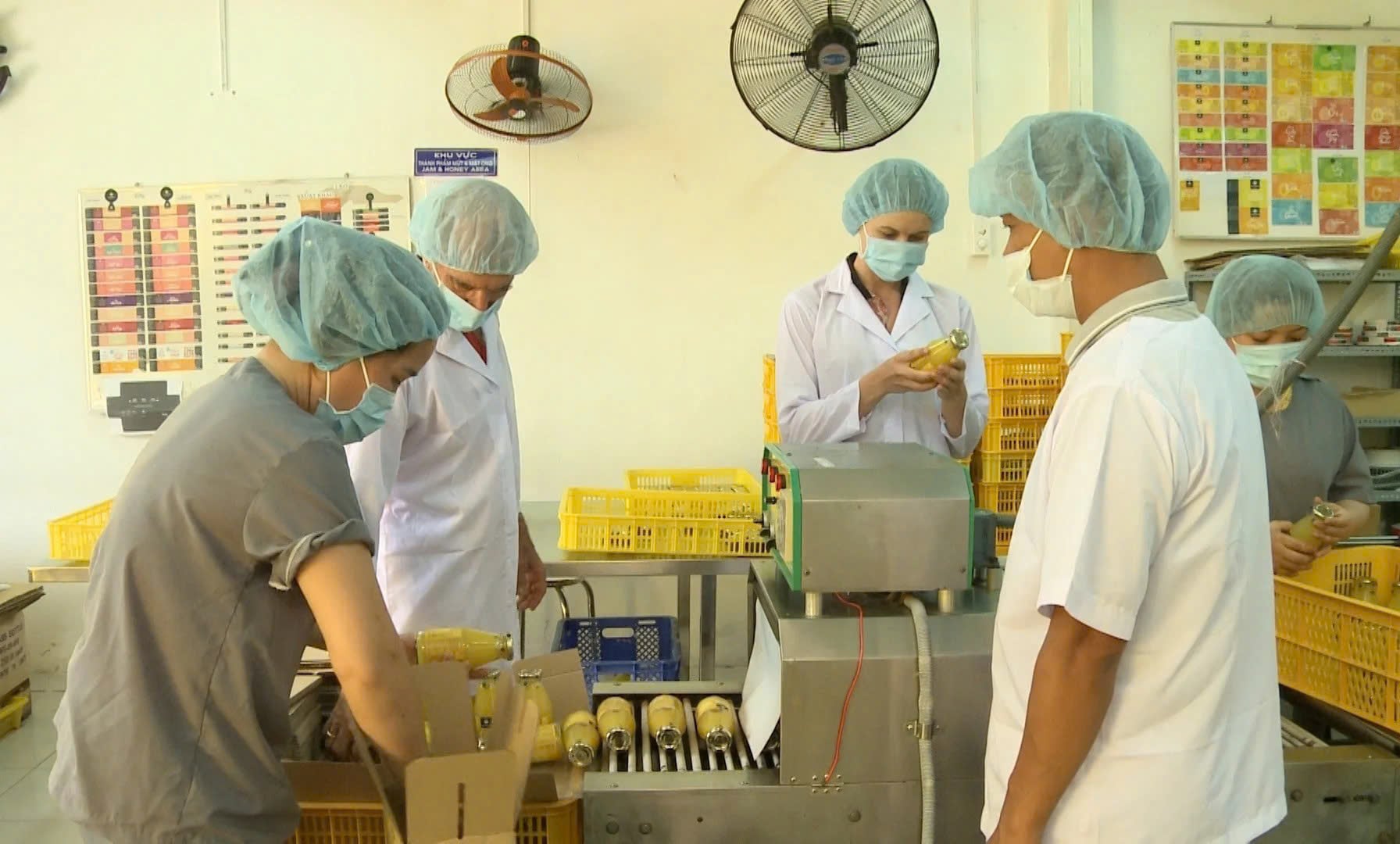
Deep processing is becoming a key growth driver for Viet Nam’s fruit and vegetable exports to the EU. Photo: Ha Duyen.
Among processed products, prepared or preserved fruit, nuts, and other edible parts of plants generated EUR 43.16 million in export value during the first five months of 2026, nearly doubling compared to the same period last year. Fruit and vegetable juices reached EUR 37.68 million, up 17.4%, while jams, fruit purées, and fruit pastes totaled EUR 7.63 million, representing a 44.8% increase.
Germany emerged as one of the strongest-performing markets. Imports of Vietnamese HS Chapter 20 products rose from EUR 12.49 million to EUR 28.24 million, an increase of 126%. In the Netherlands, imports reached EUR 33.13 million, up 28.5%. Together, these two markets accounted for more than 63% of the EU’s total imports of Vietnamese HS Chapter 20 products during the first five months of the year.
Processing opens the door to distant markets
According to Dang Phuc Nguyen, one of the biggest challenges facing the country’s fruit and vegetable sector is its persistently high post-harvest loss rate. This directly affects production costs, product quality, and the ability to export to distant markets.
“Post-harvest losses for fruit and vegetables in Viet Nam remain at around 30-40%, compared with only 10-15% in Thailand,” Nguyen said.
For nearby markets, shorter transportation times help reduce storage-related challenges. However, when exporting to the EU, products must maintain their quality over much longer periods throughout packaging, transportation, and distribution.
“Proper preservation is essential for exporting agricultural products to distant markets. Air freight is fast but expensive, while sea freight is more economical but requires effective preservation solutions,” he emphasized.
Nguyen noted that domestic fruit and vegetable production continues to expand, while export growth cannot rely solely on neighboring markets. To strengthen access to the EU and other distant destinations, the industry must invest more heavily in post-harvest technologies, cold storage facilities, refrigerated logistics, and other solutions that extend product shelf life.
In this context, food processing helps businesses overcome part of the geographical barrier. Unlike fresh produce, agricultural products can be frozen, dried, milled into powder, processed into purées or juices, or manufactured into other shelf-stable products with much longer storage lives.
Processing also creates additional market opportunities for produce that may not meet the size or appearance standards of the fresh market but still meets quality requirements for processing. As a result, businesses can utilize a larger share of harvested output, reduce post-harvest losses, and generate greater value from each unit of agricultural produce.
Expanding processing capacity is therefore not only a way to obtain higher export prices but also an effective strategy to extend shelf life, minimize waste, and enable Vietnamese fruit and vegetable products to reach distant markets such as the European Union.
Nevertheless, processed products exported to the EU must still comply with stringent requirements on food safety, pesticide residue limits, traceability, ingredient specifications, and product labeling. This means that quality control must begin at the production stage in growing areas rather than relying solely on processing at manufacturing facilities.
$ 1 = VND 26,460 – Source: Vietcombank.
Agriculture News | Agri Products Price