



(VAN) An innovative rice-lifting attachment mounted on tractors, developed by two young men in Cam Lam, is helping reduce manual labor, improve economic efficiency, and promote synchronous mechanization.
Operational efficiency of the homemade lifting system
During the recent harvest season, in the rice fields of Tan Sinh Tay hamlet, Cam Lam Commune, Khanh Hoa province, a mobile agricultural loading and unloading system has been operating continuously with high efficiency. Amid the bustling harvest, the machine seamlessly performed a series of lifting, rotating, and loading operations, placing sacks of harvested rice neatly and accurately onto trailers positioned behind the vehicle, even on the undulating terrain of the paddy fields.
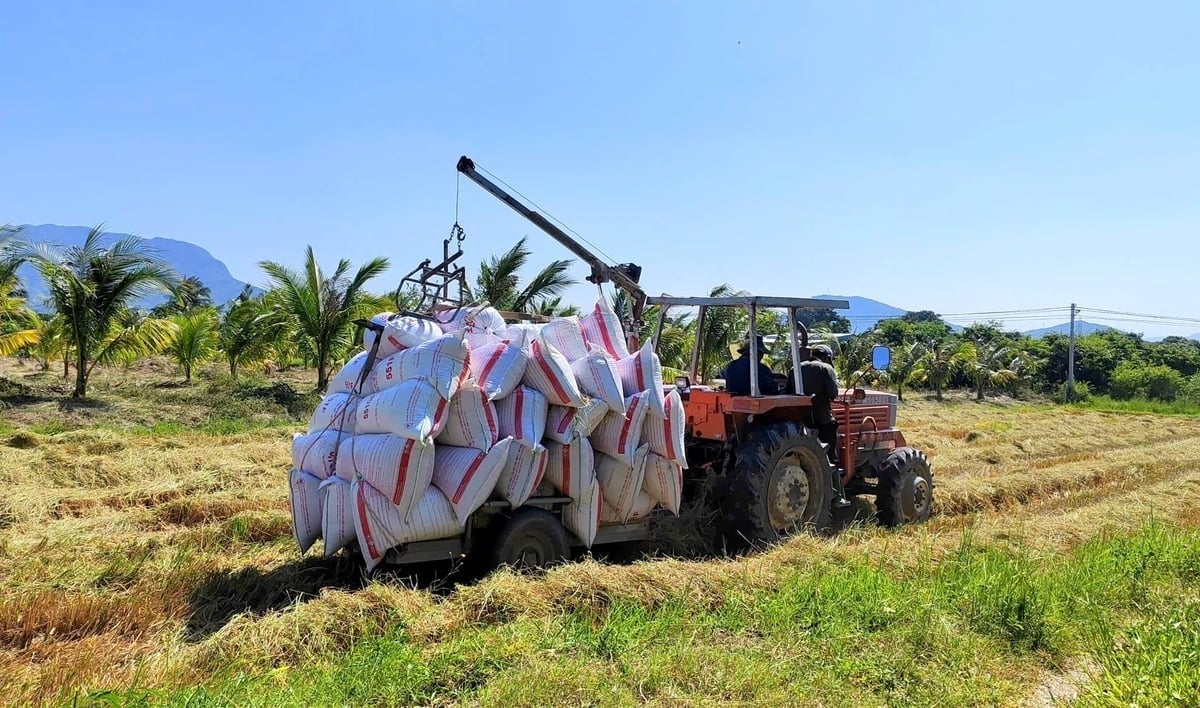
Two young men in Cam Lam have invented a rice-lifting attachment that helps ease farmers’ workload. Photo: KS.
The introduction of this device has completely transformed the traditional manual loading method, which previously required considerable time and labor from local farmers. The innovative system was co-invented by Nguyen Huu Nhat (born in 1996), a graduate in land administration, and his older brother Nguyen Huu Thong, a local mechanical engineer. The two co-inventors have directly improved the design based on their family’s actual needs.
The multifunctional rice-lifting device is designed to be permanently mounted onto the rear hydraulic lifting system of an existing 61-horsepower tractor, which is coupled with a trailer at the rear. In terms of operation mechanism, the system incorporates a rotating crane and a flexible mechanical gripping system controlled by hydraulic pressure.
During operation, a worker in the field positions the gripping clamp onto the rice sacks. The crane system then lifts the sacks from the paddy field, swings them sideways, and places them neatly in stable tiers on the trailer. The process requires close coordination between the tractor operator, who controls the rear lifting system, and the worker on the ground, enabling the equipment to operate efficiently across the challenging terrain of harvested rice fields.
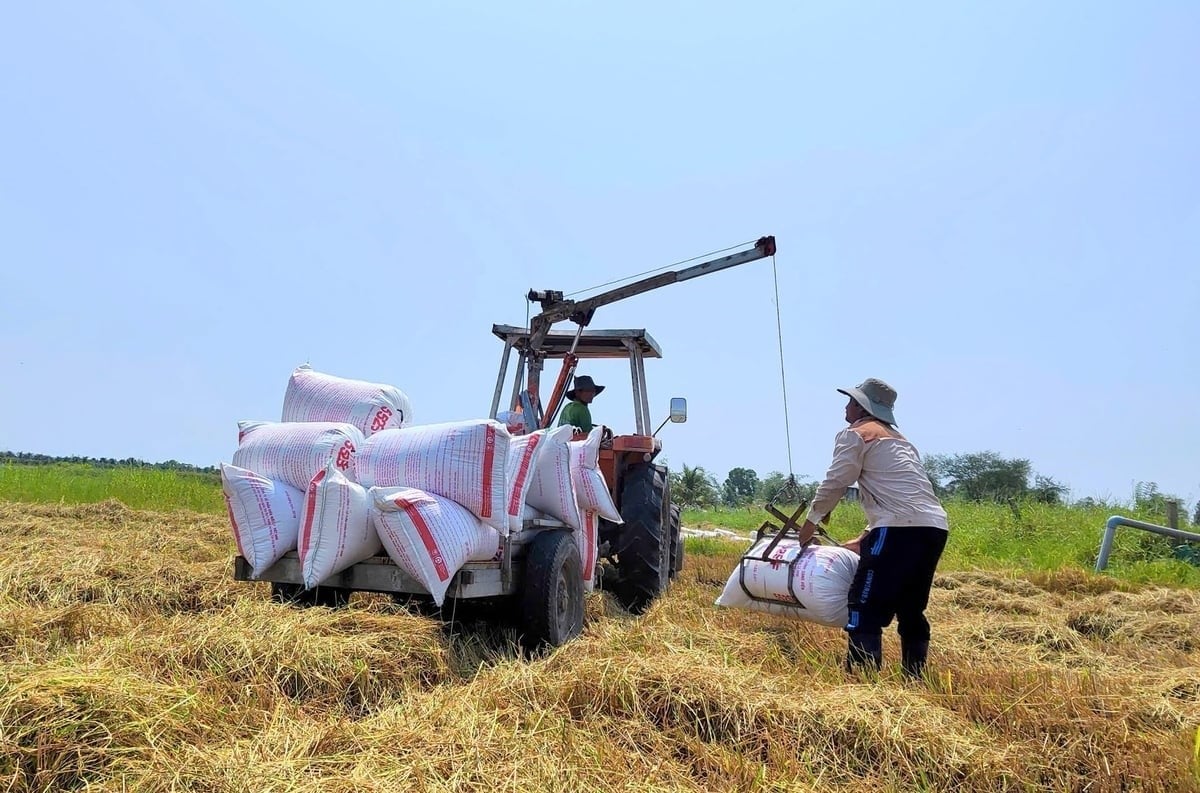
Operating the machine requires close coordination between the tractor operator, who controls the rear lifting system, and a worker accompanying the machine in the field. Photo: KS.
Explaining the motivation behind the invention, the young inventors said that one of the greatest pressures facing farmers today lies in the post-harvest loading and transportation of agricultural products. On average, when rice yields are high, farmers must mobilize labor to manually handle more than 130 sacks of rice per hectare. The work demands considerable physical endurance, as laborers must continuously lift and stack heavy rice sacks above head height in intense heat.
Meanwhile, the supply of seasonal labor in the locality has become increasingly scarce and costly, often disrupting the transportation of harvested rice from the fields to drying yards. It was these concerns over the hardship experienced by their own family and neighboring farmers that motivated the two young men to develop this mechanized solution.
The homemade lifting attachment, combined with a towing trailer, has delivered remarkable results, achieving a loading capacity of up to 400 rice sacks per day. The machine has effectively replaced manual labor, allowing farmers to take full control of the timing of rice collection and transport directly to collection points. By reducing the need for physical labor, the system helps minimize fatigue among farmers, shorten field-clearing time, ensure timely collection and transportation of harvested rice, and reduce post-harvest losses due to unpredictable weather.
Potential for replication
Tran Danh, Head of Tan Sinh Tay Hamlet, said that the innovative rice-lifting machine is a breakthrough initiative developed by Thong and Nhat. In particular, Nguyen Huu Thong possesses a solid academic background, having graduated with a degree in mechanical engineering. Drawing on their technical expertise, the two inventors independently conducted research, used locally available materials, and repurposed components from old vehicles to minimize production costs.
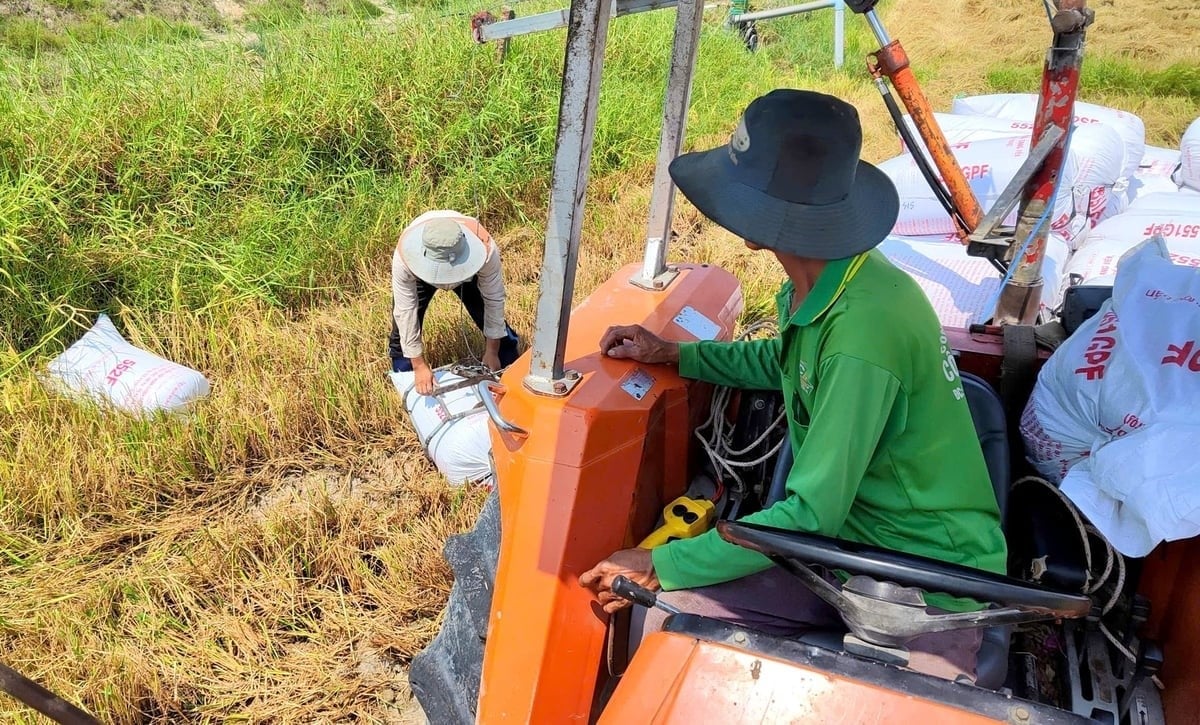
The machine has effectively replaced manual loading labor. Photo: KS.
The core of this innovation lies in the design of the gripping mechanism, which is mounted directly onto the family’s existing tractor and integrated with the tractor’s original hydraulic lifting system. Only the missing specialized components had to be purchased from the city for installation and final assembly.
Having witnessed the machine operating in the field, Tran Danh assessed that the equipment performed very effectively, helping free local farmers from strenuous manual labor. The innovation offers substantial practical value, particularly for elderly agricultural workers, who no longer have to manually carry heavy rice sacks as they did for many years.
From its clear economic and social benefits, Tran Danh, Head of Tan Sinh Tay Hamlet, believes the model has considerable potential for replication. He suggested that this innovation should be introduced more widely to farming households within the hamlet and neighboring areas in order to improve harvesting efficiency across the region.
Agriculture News | Agri Products Price