



(VAN) Fruit and vegetable exports posted strong growth in the first four months of the year, boosting confidence that the sector will reach a total export turnover of USD 10 billion this year.
According to the Viet Nam Fruit and Vegetable Association (Vinafruit), despite numerous challenges, fruit and vegetable exports in the first four months of this year recorded impressive growth, reaching nearly USD 2.06 billion, up 22% from the same period in 2025.
In terms of markets, China continues to affirm its position as the largest market, accounting for more than 50% of total share with turnover reaching over USD 1 billion. Meanwhile, other key markets such as South Korea, the U.S., Japan, and the Middle East have maintained good growth rates of 15–20%.
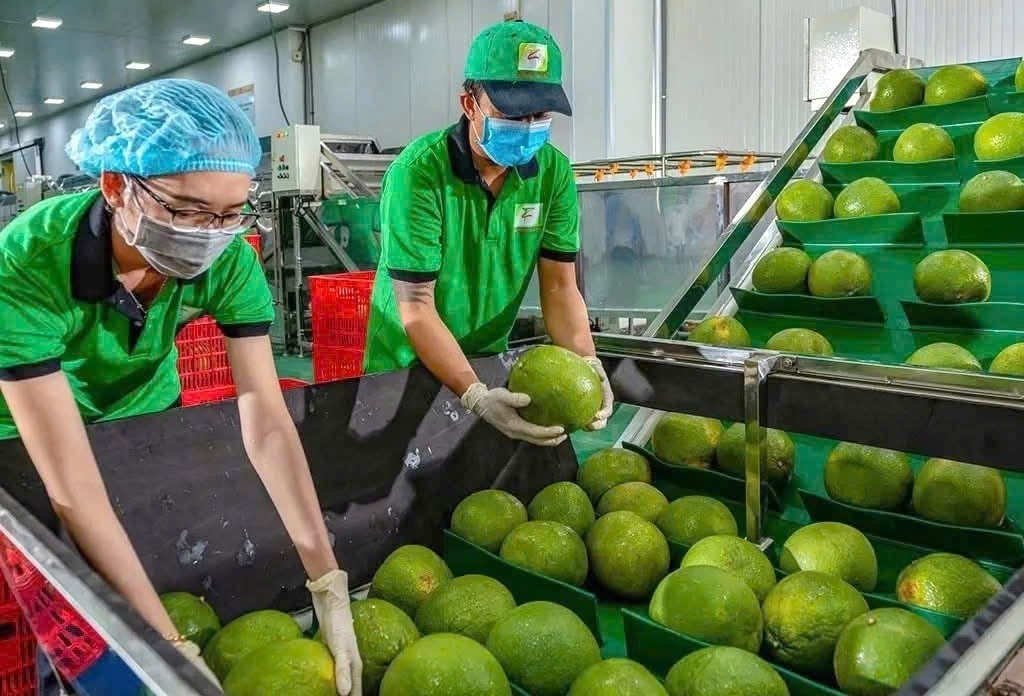
Pomelo processing at the factory of Chanh Thu Fruit Export-Import Group Joint Stock Company. Photo: Viet Huong.
Particularly, demand for Vietnamese fruit and vegetable imports is increasing across many major markets. According to data from the European Commission’s statistical office, although the EU reduced imports of fruit and vegetables from extra-EU markets in the first month of 2026, imports from Viet Nam still rose by 7.8% compared to January 2025. This indicates that Viet Nam’s fruit and vegetable sector is increasingly meeting the EU’s green and sustainable standards.
Data from the U.S. International Trade Commission (USITC) show that in the first two months of this year, the U.S. reduced overall imports of vegetables, fruits, and processed products but increased imports from Viet Nam. This growth indicates that Vietnamese fruit and vegetable products are increasingly aligning with healthy consumption trends in the U.S. market, particularly key products such as pomelos, coconuts, and certain processed items.
By region, Viet Nam’s fruit and vegetable exports have grown strongly. According to the Agency for Foreign Trade (Ministry of Industry and Trade), in the first quarter of 2026, the sector maintained export growth to all regions worldwide.
Among them, although accounting for the smallest share, exports to Africa recorded the highest growth rate at 38.4%. Following were the EU with a growth rate of 34.2%, Asia at 32%, Oceania at 23.9%, and the Americas at 19.5%. These strong growth rates reflect the rising position of Vietnamese fruit and vegetable products in the global market.
Regarding export methods to China’s largest market, while informal (border trade) exports remain due to logistical flexibility, official exports are increasingly playing a dominant role.
A notable development in fruit and vegetable exports is the positive shift in export structure toward higher added value, as the share and turnover of processed fruit and vegetable products continue to rise. Enterprises are increasingly investing in deep processing, such as frozen products, dried products, and concentrated fruit juices. These factors not only enhance the value of Vietnamese fruit and vegetables but also contribute significantly to export growth.
Mr. Nguyen Thanh Binh, Chairman of Vinafruit, noted that the recent visit to China by General Secretary and State President To Lam has further strengthened the comprehensive relationship between the two countries, including trade ties. This creates favorable conditions for Viet Nam’s fruit and vegetable sector to boost exports to China in the coming period.
China continues to open its market to Vietnamese fruit and vegetables, most recently by signing a protocol that allows the official export of Vietnamese pomelos and lemons. This represents a highly significant boost for pomelo and lemon exports in particular and for fruits and vegetables in general to the Chinese market.
On that basis, Mr. Binh believes that if the strong growth momentum seen in the first four months is maintained, Viet Nam’s fruit and vegetable exports could fully achieve the target of USD 10 billion this year.
However, to reach this target, Mr. Binh emphasized the need to address several issues that are currently hindering the growth of fruit and vegetable exports.
First, some export consignments of Vietnamese fruit and vegetables have still received warnings from markets such as the EU, Japan, and China for issues including pesticide residues, banned substances, and heavy metals. Therefore, it is essential to focus on improving product quality and ensuring compliance with food safety standards for exports.
In the context of market contraction due to conflicts in the Middle East, efforts should be made to better tap into other markets. For instance, China remains the largest market for Vietnamese fruit and vegetables and continues to hold significant untapped potential.
Through surveys and working sessions with localities across China, Vinafruit has found that in many inland areas, including Beijing, Chongqing, Shanghai, Hunan, and Zhengzhou, Vietnamese fruit and vegetables remain relatively scarce. Therefore, there is considerable room to further exploit the Chinese market to offset declines in markets affected by Middle East conflicts.
Agriculture News | Agri Products Price