

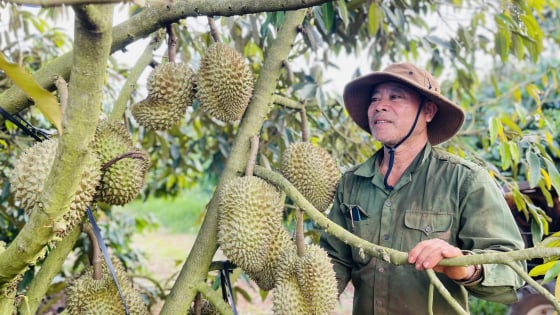
(VAN) To achieve long-term growth, Viet Nam’s durian industry must reorganize raw material production areas, strengthen value chain linkages.
Reorganizing raw material production areas
Recent market fluctuations have not only caused durian prices to plunge and created challenges for exports but have also exposed shortcomings in production organization. As export markets continue to raise technical standards, the current challenge is to standardize the entire value chain rather than applying temporary solutions to individual problems as they arise. The entire raw material production system must be reorganized in a more professional and synchronized manner, with close linkages established among growers, cooperatives, and businesses.
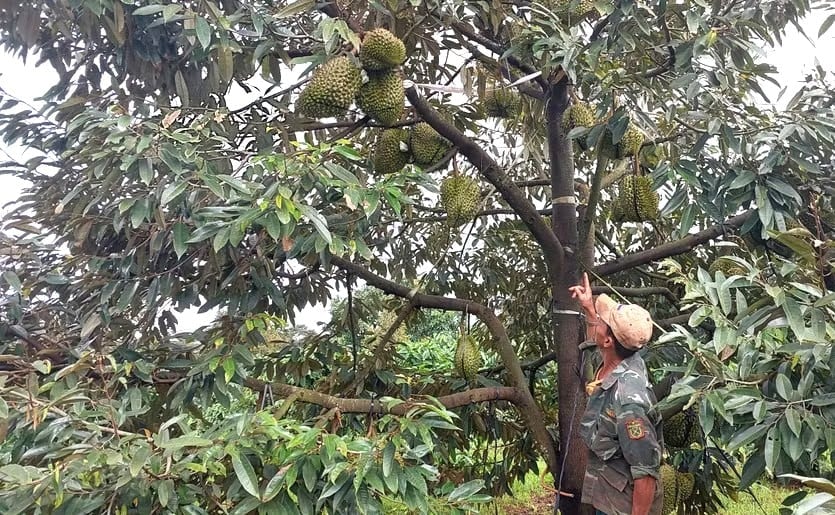
A durian orchard in Gia Lai has been granted a planting area code. Photo: DL.
According to Mr. Dang Phuc Nguyen, General Secretary of the Vietnam Fruit and Vegetable Association, requirements for growing area codes, packing facility codes, and traceability are becoming mandatory conditions for export activities. This means the durian industry can no longer continue to develop under the previous model of fragmented production, where each household follows its own practices.
Mr. Nguyen said that as markets increasingly value product transparency and consistency, businesses can no longer simply collect raw materials from various scattered sources and then sort them afterward as they did in the past. To consistently fulfill export orders, companies need raw material areas that are uniformly managed in terms of cultivation processes, output, quality, and traceability. “Developing raw material areas not only helps businesses secure a proactive supply source but also creates a foundation for the durian industry to achieve sustainable long-term development,” Mr. Nguyen noted.
In addition, cooperatives need to be given a greater role in production organization. They must coordinate cultivation practices, guide farmers in complying with technical standards, and directly connect with businesses, ensuring that market requirements are quickly and consistently communicated to each member. When farmers follow the same production process, businesses can also be more proactive in developing procurement and export plans.
From the perspective of state management, Deputy Minister of Agriculture and Environment Vo Van Hung said the fundamental solution for the durian industry remains the development of standardized raw material areas, linked with the issuance of growing area codes, management of packing facility codes, and promotion of digital transformation in traceability.
According to the Deputy Minister, management cannot focus only on the export stage but must be carried out throughout the entire chain, from production, cultivation, harvesting, preliminary processing, and packaging to when products reach the market. When the entire value chain is managed in a synchronized manner, businesses will be more proactive in meeting each market’s requirements while enhancing the value and reputation of Vietnamese durian.
To support this process, the Ministry of Agriculture and Environment will continue to coordinate with localities to address challenges related to the issuance of growing area codes, traceability, the development of raw material areas, and quality inspection. According to Deputy Minister Vo Van Hung, decentralization to local authorities must be accompanied by guidance, supervision, and improved implementation capacity to ensure consistent execution and prevent new bottlenecks from emerging in export activities.
In practice, when raw material production areas are properly planned and managed, businesses are not only more proactive in securing supplies but also better positioned to develop production, processing, and export plans tailored to the requirements of each market. This also provides the foundation for the durian industry to shift from volume-based growth toward development driven by quality and value chain organization.
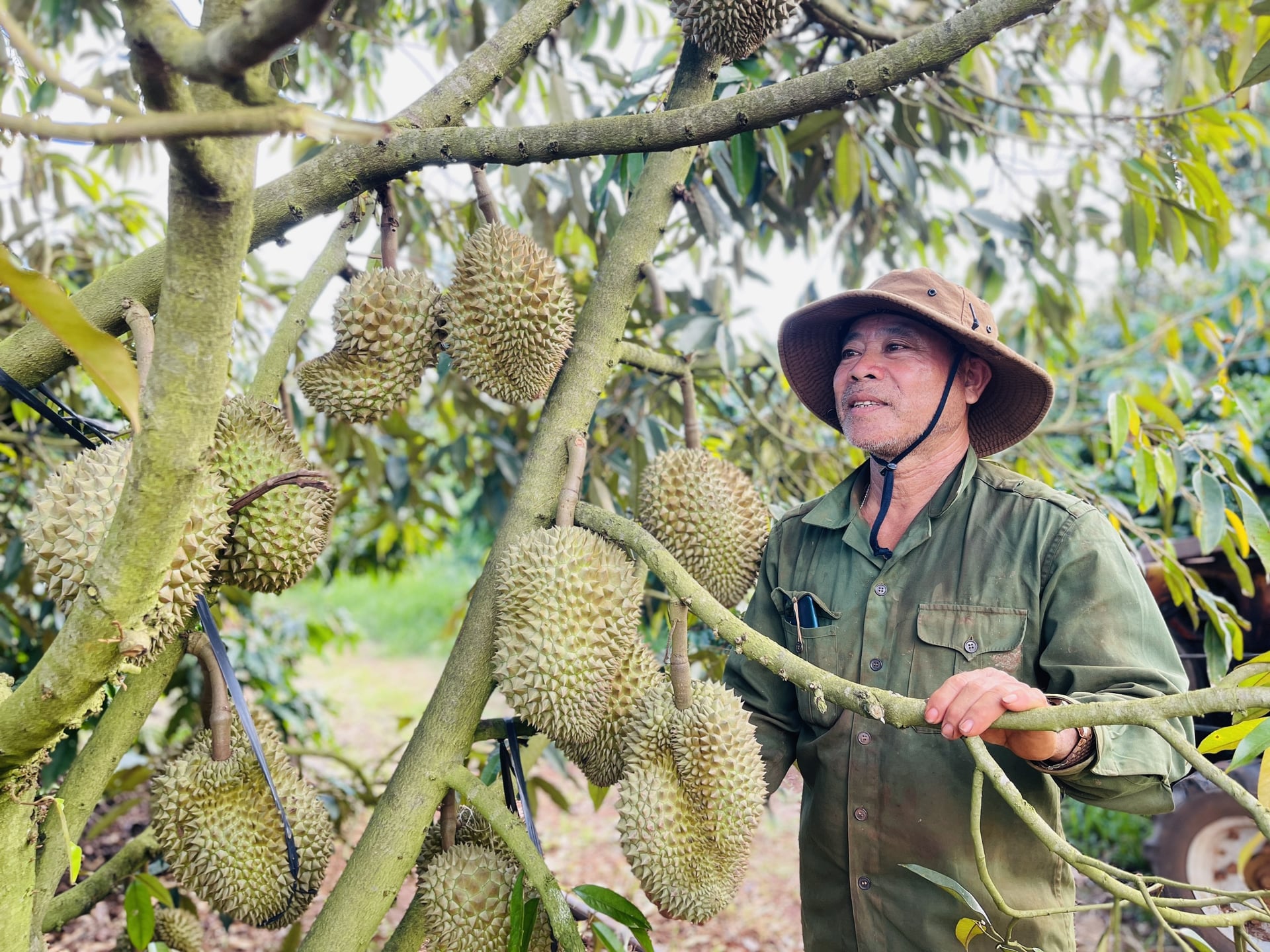
Standard-compliant durian growing areas provide the foundation for building value chain linkages, ensuring traceability, and meeting the requirements of import markets. Photo: DL.
Strengthening linkages through data
If raw material areas are the foundation, linkages are the condition that enables those areas to operate effectively. However, as import markets increasingly demand transparency in origin and quality, these linkages can no longer rely solely on purchase contracts or commitments between businesses and growers. For sustainable development, the durian production chain must be built on data, technology, and coordinated participation by all industry stakeholders.
Ms. Ngo Tuong Vy, General Director of Chanh Thu Fruit Import-Export Co., Ltd., said the company currently applies two forms of linkage. For stable raw material areas, the company signs purchasing contracts at agreed prices. For areas where procurement follows market prices, the company still provides additional financial support to cooperatives and growers who comply with technical production processes, helping maintain quality and encourage standard-based production.
The company’s goal is not simply to purchase large volumes during a single harvest season, but to build sufficiently sustainable partnerships that enable both businesses and growers to develop over many years. According to Ms. Vy, when growers have stable market outlets, they are more willing to invest in production processes and comply with market standards rather than chase short-term price fluctuations.
From a scientific perspective, Dr. Le Phong Hai, Director of the Biotech Solution Technology Transfer Center and Vice Chairman of the Vietnam Agribusiness Club, said that reorganizing raw material areas in the new phase requires support from data and technology rather than relying solely on traditional production experience.
He proposed developing cadmium contamination maps to assess heavy metal contamination levels across different growing areas, enabling businesses to proactively select qualified raw material sources and helping authorities and farmers develop soil improvement plans tailored to each area, rather than responding only after problems occur. In addition, applying GPS positioning systems and digitizing all information related to growing areas would help establish a unified database for the durian industry.
According to Dr. Hai, data will help shift management from a reactive approach to proactive governance. When raw material areas are managed through digital data, businesses can be more proactive in developing procurement plans, authorities can more easily conduct traceability, and growers can access technical recommendations suited to the conditions of each area.
However, Dr. Hai also noted that technology can only deliver real effectiveness when all stakeholders participate in a coordinated manner. Scientists provide technical solutions; businesses organize production and markets; cooperatives connect growers; while the State plays the role of planning raw material areas, improving mechanisms, and supporting the development of a shared data system for the entire industry.
Deputy Minister Vo Van Hung affirmed that sustainable development of the durian industry is not the responsibility of businesses or growers alone but requires coordination across the entire system. In addition to continuing to address immediate challenges related to quality inspection and exports, the Ministry of Agriculture and Environment will work with localities to effectively implement decentralization, strengthen state management capacity, and create conditions for value chain linkages to operate stably.
According to the Deputy Minister, when each link in the value chain performs its proper role from growers, cooperatives, and businesses to management agencies and scientists, the durian industry will have a solid foundation to adapt to increasingly stringent standards in the future.
Agriculture News | Agri Products Price