

(VAN) Aiming for $100 billion in agricultural exports by 2030, it’s necessary not only to expand markets but also to consider China as a key market.
Editor’s note: In the new era, as the agricultural sector continues to assert its role as the backbone of the economy while driving toward ambitious export targets, expanding markets and elevating the value and branding of Vietnamese agricultural products have become increasingly urgent. Behind the impressive export figures and successful shipments arriving at international ports lies the vital role of directly connecting domestic production with global markets.
On the occasion of three officials being appointed as Agricultural Counselors to China, Japan, and South Korea, as well as reflecting on Vietnam’s footprint in the US and EU agricultural markets, VAN News proudly introduces messages from representatives in key markets for Vietnamese agricultural products. This series aims to capture practical insights, proposals, and recommendations from the frontlines of international connectivity.
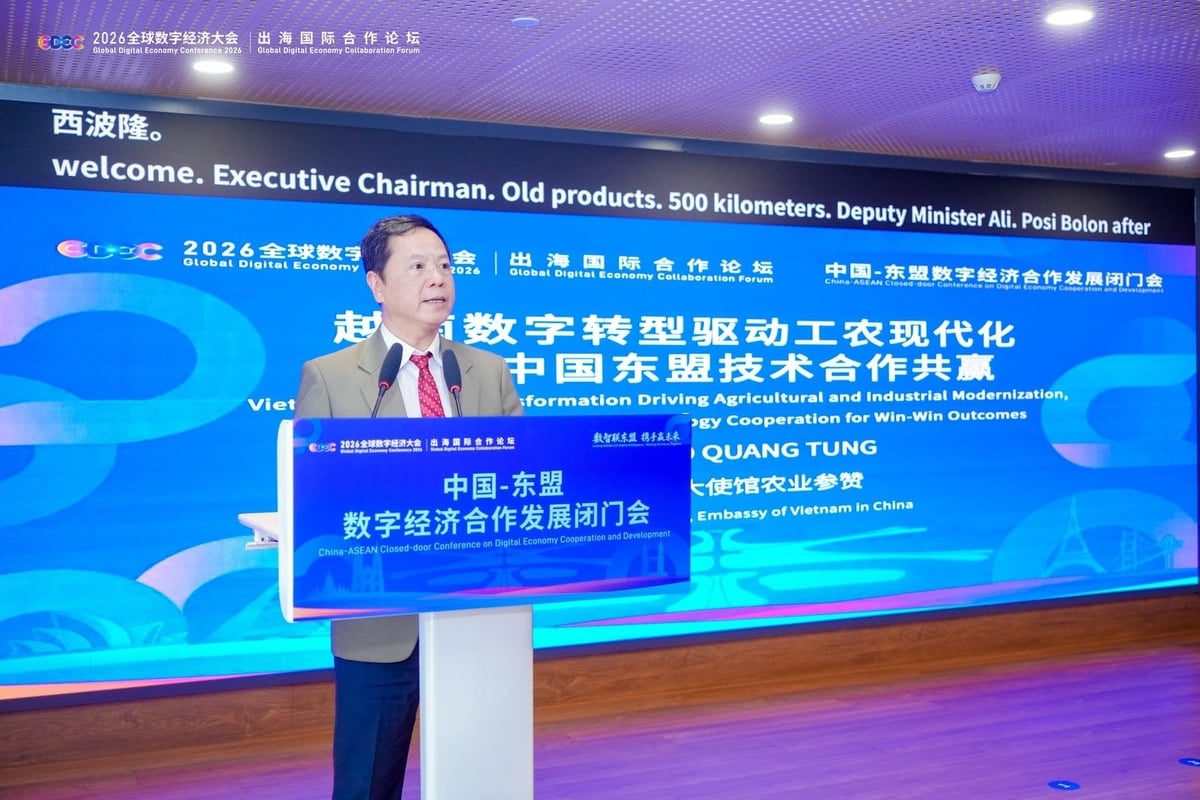
Mr. Do Quang Tung will assume the position of Agricultural Counselor in China in April 2026. Photo: VAN.
Former National Assembly Vice Chairman Le Minh Hoan wrote: “Envoys of the past carried tributes; envoys of today carry questions,” the role of an Agricultural Counselor must be deeply imbued with the understanding that learning, researching best practices, and identifying modern science, technology, or efficient models constitute one of the foremost missions to bring back “a new way of thinking, a new way of doing, and a new confidence” for the country’s agriculture.
The mindset of an agricultural ambassador in the new era
If envoys of the past carried tributes to establish diplomatic relations, today, in our role as the Agricultural Counselor to China, we carry “questions.” These are questions about the preferences of 1.4 billion consumers, the stringent standards of a market that is no longer “easy-going,” and how to ensure that Vietnamese agricultural products not only appear but also stand firm and build a reputable brand.
These questions are not meant to express hesitation, but to unlock opportunities. The Chinese market, one of the largest agricultural markets globally, is changing rapidly in terms of scale, structure, and consumption standards.
Since 2019, China has surpassed the EU and the United States to become the world’s largest and market-leading importer of agricultural products. With the world’s second-largest population (accounting for 18% of the global population) but holding only 10% of the world’s arable land, China will remain dependent on agricultural imports over the long term, particularly from tropical countries like Viet Nam and fellow ASEAN nations.
“Official export channels” – A strategic direction and high-level opportunities
We have moved past the era of mere “cross-border trade.” Thanks to the efforts of both sides, most Vietnamese agricultural products have gradually transitioned toward “official export channels.” This is not just an administrative or procedural shift, but a complete transformation in production and business mindsets.
Leveraging geographical proximity and robust logistics systems, China has steadily become one of Viet Nam’s largest agricultural import partners. Among these, flagship commodities such as fruits and vegetables, seafood, coffee, rubber, and cassava are identified as growth engines and hold priority status in the strategy to expand exports to this market.
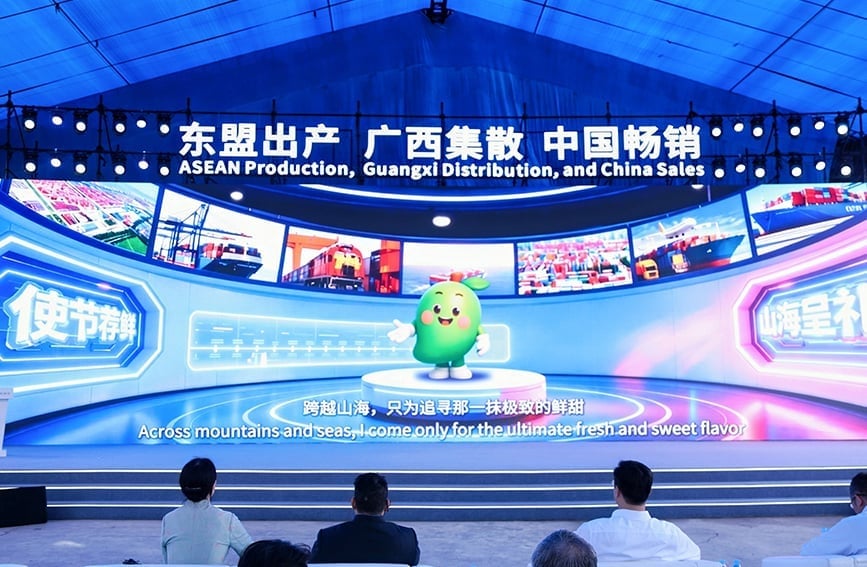
The “ASEAN Fruit Gathering in Guangxi” Initiative focuses on fruits and fruit products from ASEAN countries penetrating the Chinese market. Photo: Organizing Committee.
Notably, the recent visit to China by General Secretary To Lam has unlocked unprecedented windows of opportunity. Commitments regarding smart border gates, high-speed railways, and modern logistics hubs are turning transportation hurdles into competitive advantages in speed and cost.
However, opportunities always come hand in hand with challenges. A series of technical barriers are continuously tightening, ranging from phytosanitary regulations and food safety to packaging and labeling standards. Competition from regional peers, especially other ASEAN countries, is also growing increasingly fierce. In this context, Vietnamese agricultural products cannot rely solely on natural advantages or high volumes; they must assert their position through consistent quality, clear branding, and the ability to adapt flexibly to market demands.
Finding answers for “New ways of doing”
As we work toward the $100 billion agricultural export target by 2030, alongside market diversification, we must identify China as a core market to increase market share and value.
Grounded in that reality, we have determined that the mission of a Counselor does not stop at trade promotion or facilitating meetings. We are here to find answers to market equations. This involves researching consumer trends, updating policies, identifying technical barriers early, and providing timely support to resolve bottlenecks that arise during the export process. Every piece of gathered information and every recorded market shift serves as vital data to be translated into concrete recommendations for domestic enterprises and producers.
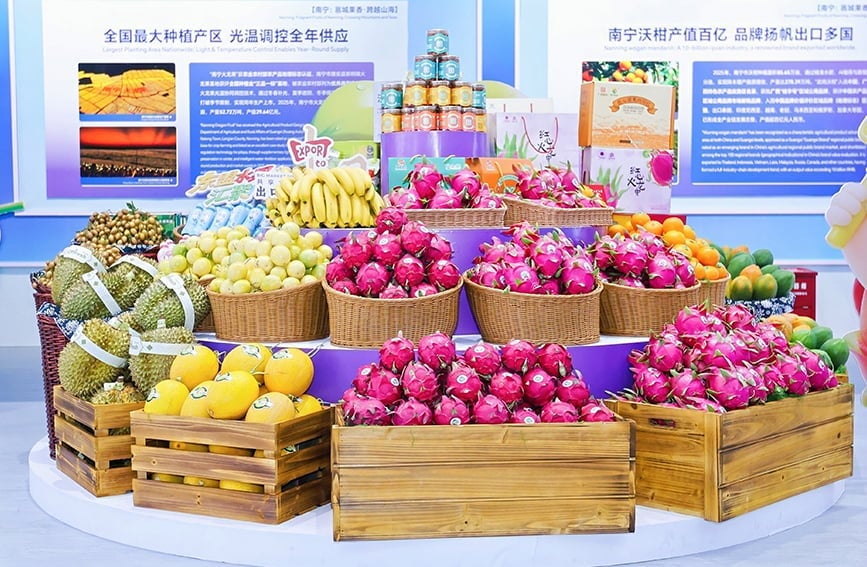
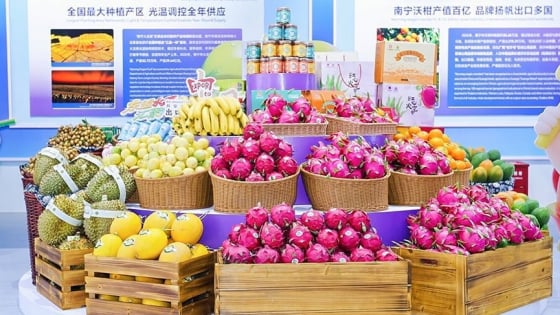
The ASEAN fruit pavilion at the event “Made in ASEAN, Distributed in Guangxi, Sold Across China” in Nanning City (Guangxi Province), June 2026. Photo: Organizers.
But to achieve this, we cannot walk alone. Through the Agriculture and Environment Newspaper, I hope to hear much more from back home, from farmers, traders, and businesses to scientists and managers. Simultaneously, we will serve as an extension, promptly conveying market fluctuations and early warnings to everyone. Let us work together to turn each agricultural product into a cultural ambassador, ensuring that Vietnamese agriculture remains strong and reaches further!
That is the message that I, as the Agricultural Counselor to China, wish to send to everyone accompanying Vietnamese agriculture today.
Author: Dr. Do Quang Tung