
By using this site, you agree to the Privacy Policy and Terms of Use.
Accept
Agriculture News - Mekong FarmerAgriculture News - Mekong FarmerAgriculture News - Mekong Farmer
  • Home
  • Technology
    TechnologyShow More
    Agtech Seedlings: Bonsai Robotics secures $15M to advance automated fruit harvesters
    By nhanongen
    Deere loses appeal against Agco in patent dispute over precision planting technology
    By nhanongen
    Investment in agtech startups plummeted in 2024
    By nhanongen
    Mekong Farmer to stop publishing
    By nhanongen
    Agtech Seedlings: CH4 Global to expand methane-reducing cattle feed with Mitsubishi
    By nhanongen
  • Mekong Deta
    Mekong Deta
    Show More
    Top News
    Farmers growing jicama are at risk of losing money because prices have plummeted
    07/06/2024
    Thousands of pots of Tet raspberry chrysanthemums were thrown away because of slow flowering
    13/11/2024
    Farmers growing vegetables and fruits do not use chemical fertilizers
    14/08/2025
    Latest News
    ‘Thuan Thien’ solution to detoxify cadmium for durian
    16/05/2026
    Farmers in the West are devastated because durian prices have plummeted
    10/05/2026
    Turn saline alkaline soil into billion-dollar vineyards and tomatoes
    04/05/2026
    Ca Mau established a museum, erecting a symbol of three rice grains 24 m high
    25/04/2026
  • Supply Chain
    Supply ChainShow More
    Meat giant JBS breaks into the egg business
    By nhanongen
    Zeldin is confirmed as the new EPA administrator. What’s next?
    By nhanongen
    US detects rare bird flu strain H5N9 in poultry for first time
    By nhanongen
    Lend an ear: Corn-based material introduced for biodegradable packaging
    By nhanongen
    Why an independent grocer is holding the line on egg prices
    By nhanongen
  • Meat
    MeatShow More
    Cargill, Foster Farms to close turkey plants as demand wanes
    By nhanongen
    Cargill, Foster Farms to close turkey plants as demand wanes
    By nhanongen
    Smithfield raises 25% less than expected in muted IPO
    By nhanongen
    Egg prices could break more records in 2025
    By nhanongen
    USDA slow to update food safety standards for meat and poultry, watchdog finds
    By nhanongen
  • Agri Products Price
    Agri Products Price
    Update Agri Products Price: Coffee, Pepper, Rice, Durian, Jackfruit
    Show More
    Top News
    Pepper prices on 06/16/2024: Mixed movements
    17/06/2024
    The price of raw Salanganes Nest decreased to 516
    09/07/2024
    Sharp reversal and a significant drop
    28/07/2024
    Latest News
    Coffee prices on July 30, 2026: Global markets plunge sharply
    30/07/2026
    Rubber prices on July 29, 2026: Positive momentum globally
    30/07/2026
    Disease-resistant chili variety priced at VND 170,000/kg
    27/07/2026
    Rubber prices on July 27, 2026: Mixed movements globally
    27/07/2026
  • Markets
  • Regulations
Notification Show More
Font ResizerAa
Agriculture News - Mekong FarmerAgriculture News - Mekong Farmer
Font ResizerAa
  • Agri Products Price
  • Meat
  • Markets
  • Mekong Deta
  • Technology
  • Supply Chain
  • Categories
    • Mekong Deta
    • Markets
    • Agri Products Price
    • Meat
    • Technology
    • Supply Chain
  • More Foxiz
    • Blog Index
    • Sitemap
Follow US
Blog > Markets > Leveraging ‘low-risk’ country status, Vietnamese coffee moves to meet EUDR
Markets

Leveraging ‘low-risk’ country status, Vietnamese coffee moves to meet EUDR

nhanongen
Last updated: 02/08/2026 11:11 AM
By nhanongen
Share
6 Min Read
SHARE


Contents
Capitalizing on low-risk statusExpanding the traceability foundation


(VAN) Classified by the EU as a low-risk country, Vietnamese coffee has additional advantages to expand traceability, proactively adapt to the EU Deforestation Regulation (EUDR), and hold onto a key export market.

Capitalizing on low-risk status

According to statistics from the Customs Department, in the first six months of 2026 Vietnam exported more than 1.05 million tons of coffee, earning $4.81 billion, up 7.4 percent in volume but down 13.8 percent in value due to lower average prices across global markets.
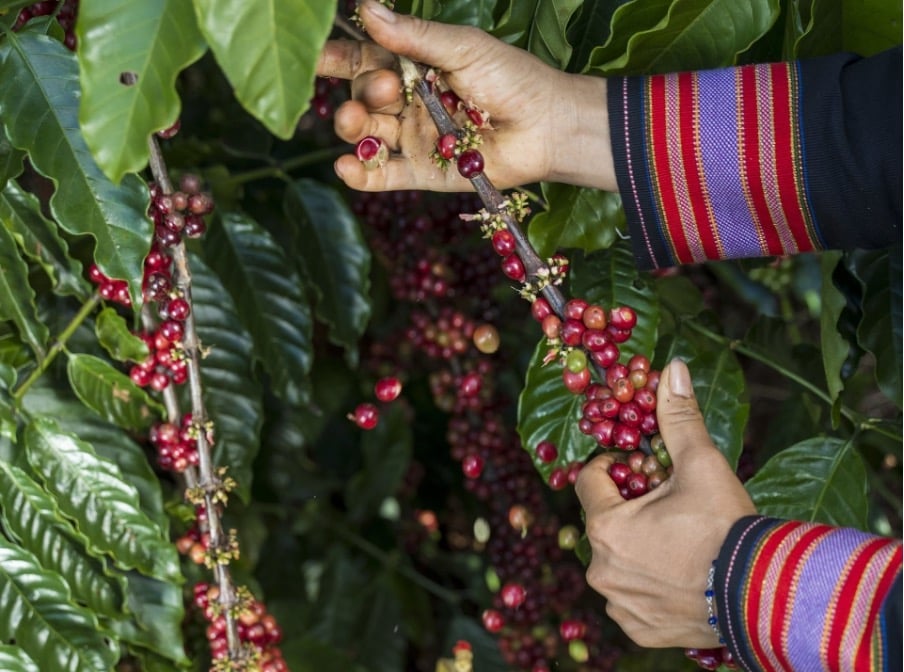
Harvesting ripe coffee cherries in a growing area, a key step in the traceability chain from farm to export product. Photo: Vinh Hiep.

Harvesting ripe coffee cherries in a growing area, a key step in the traceability chain from farm to export product. Photo: Vinh Hiep.

Europe remains a key export region for Vietnamese coffee. Germany, Italy, Spain, Belgium, and the Netherlands alone imported more than 409,700 tons of Vietnamese coffee, worth roughly $1.735 billion. Export volumes to Germany, Italy, Spain, and Belgium all increased compared with the same period last year, underscoring the resilience of demand in these core markets even as prices softened.

Viet Nam is the EU’s 12th-largest agricultural export partner, reflecting the growing depth of Vietnamese farm produce’s integration into the bloc’s supply and consumption chains. Complying with the EU Deforestation Regulation (EUDR) is a condition for Vietnamese coffee to keep its foothold in the market and strengthen its competitiveness against other origin countries vying for the same shelf space.

Under the regulation, coffee entering the EU must be proven deforestation-free, legally produced, and traceable to its production area, with documentation required at every stage from farm to final shipment.

The EUDR will take effect on December 30, 2026 for large and medium-sized enterprises, and on June 30, 2027 for most micro and small enterprises. Viet Nam holds an advantage as a country the EU has classified as low-risk, meaning goods of Vietnamese origin are subject to a simplified due-diligence mechanism, though they must still fully meet traceability requirements and cannot bypass the underlying documentation standards.

According to Nguyen Nam Hai, Chairman of the Viet Nam Coffee-Cocoa Association (Vicofa), ever since the EUDR took legal effect in 2023, ministries and government agencies have developed implementation roadmaps for localities and enterprises, laying the groundwork well ahead of the compliance deadlines.

Early preparation has helped a portion of coffee growing areas and supply chains gradually complete their data systems, positioning them to meet the EU market’s new requirements without disruption to existing trade relationships.

“Viet Nam has an advantage in being classified by the EU as a low-risk country. Foreign buyers are now showing interest in and seeking out Vietnamese coffee sources capable of meeting EUDR requirements,” Hai said.

According to the Vicofa chairman, some compliant supply sources are currently commanding prices roughly $50 per ton above the market rate. While that premium may vary by time and by transaction, the trend shows that transparency in sourcing is gradually translating into commercial value, giving compliant producers a tangible incentive to invest in traceability infrastructure.

“Low-risk status, combined with international buyers’ interest, opens an opportunity for Vietnamese coffee to maintain its EU market share once the new regulation takes effect. The ability to meet sustainability requirements can help enterprises boost competitiveness, retain long-term customers, and create additional leverage in negotiations for supply sources with clear data,” Hai said.

Expanding the traceability foundation

According to Vicofa estimates, about 35-40 percent of current coffee supply is capable of meeting EUDR requirements. This forms the foundation for the industry to continue expanding growing areas and supply chains that meet requirements before the regulation takes effect, with the remaining share requiring further investment in mapping and data collection.
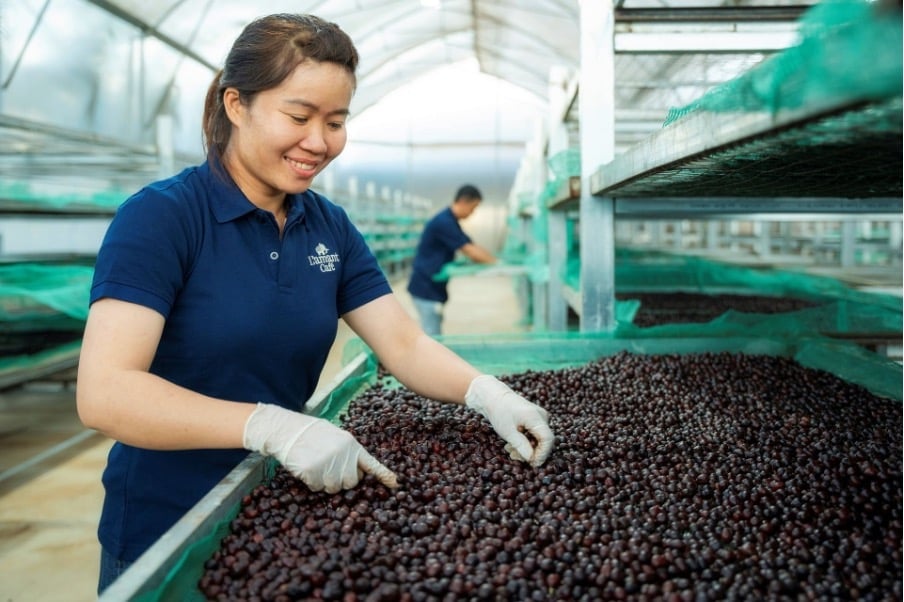
Coffee is processed and quality-checked after harvest before moving into production. Photo: Vinh Hiep.

Coffee is processed and quality-checked after harvest before moving into production. Photo: Vinh Hiep.

Nguyen Nam Hai said domestic coffee production relies mainly on smallholder households, while the purchasing process involves cooperatives, agents, and traders. As a result, traceability cannot be implemented only at the growing area or export stage, but must be carried out across the entire system.

Information on land plots, growers, purchasing, sorting, storage, and processing needs to be linked to each export shipment. EUDR-compliant supply sources also need to be identified and separated starting at the point of purchase, ensuring origin data is maintained as coffee passes through intermediary stages.

“When the entire system participates, traceability will not be broken between the growing area and the export shipment. In the long run, this foundation will not only serve EUDR compliance but also support quality management, strengthen chain linkages, and improve the ability to meet sustainability standards worldwide,” Hai emphasized.

Hai proposed that the Ministry of Agriculture and Environment continue rolling out the EUDR implementation roadmap to localities, enterprises, and related organizations. Cooperatives, agents, and traders need to be brought into the traceability system, while smallholder households need support with mapping, record-keeping, and the use of digital platforms.


Agriculture News | Agri Products Price

- Advertisement -
Share This Article
Facebook Twitter Copy Link Print

Fast Four Quiz: Precision Medicine in Cancer

How much do you know about precision medicine in cancer? Test your knowledge with this quick quiz.
Get Started
Pepper exports sustain double-digit growth

(VAN) Pepper exports maintained double-digit growth in the first half of…

The US Embassy in Vietnam aims to elevate ‘fruit diplomacy’

The concept of 'fruit diplomacy' between Vietnam and the United States…

Cooperative’s organic pepper sells at VND 15 million/kg

(VAN) After efforts for certifications, Bau May pepper products are priced…

- Advertisement -

Your one-stop resource for medical news and education.

Your one-stop resource for medical news and education.
Sign Up for Free

You Might Also Like

Markets

Minh Phu proposes developing disease-resistant shrimp varieties

By nhanongen
Markets

Vietnamese tilapia exports flourish, but faces fiercecompetition.

By nhanongen
Markets

Ca Mau’s seafood exports exceed USD 1.3 billion

By nhanongen
Markets

Removing bottlenecks to boost Viet Nam’s shrimp industry

By nhanongen
Facebook Twitter Youtube

Giá cả nông sản
Mekong Delta News
Agriculture News
Agri Products Price

Categories
  • Home
  • Technology
  • Mekong Deta
  • Supply Chain
  • Meat
  • Agri Products Price
  • Markets
  • Regulations
Nhà Nông Miền Tây
  • Giá cà phê hôm nay
  • Giá lúa gạo hôm nay
  • Giá mít ruột đỏ hôm nay
  • Giá mít thái hôm nay
  • Kết quả xổ số Miền Nam
  • Kết quả xổ số Ngọc Minh
  • Xổ số Ngọc Minh
  • Kết quả xổ số
  • Kết quả xổ số Kiên Giang
  • Xổ số Kiên Giang
Italy Highlights
  • Italy Highlights
  • Italy Attractions
  • Travel to Italy
  • Italy Food
  • Trip Ideas in Italy
  • Real Estate in Italy
  • Crypto News
  • Finances News
  • Investing News
  • Economic News
Architecture Concept
  • Architecture Concept
  • Interior Design
  • Landscape Design
  • Bath Products
  • Kitchen Products
  • Home Renovating
  • Architecture Project
  • Lighting Design
  • Mekong Farmer
  • Mekong News
- Advertisement -
Thị trường nông sản

© 2024 Mekong Farmer
– Agriculture News.
A member of Nhanongmientay.com

© 2024 Mekong Farmer - Agriculture News
Welcome Back!

Sign in to your account

Lost your password?