

(VAN) The shrimp industry has set a goal of developing in a green, modern, efficient, and sustainable direction, with the goal of making Viet Nam one of the world’s leading shrimp production and export hubs.
At a conference with industry associations on promoting agricultural, forestry, and fishery exports in the second half of 2026, held on July 30, Mr. Mai Van Hoang, Chairman of the Viet Nam Shrimp Association (VSA), said the shrimp industry continues to play a role as one of Viet Nam’s key seafood export commodities, with a number of positive signals.
However, behind the growth momentum lies a series of bottlenecks that need to be addressed promptly if the industry is to maintain its competitive advantage in the coming years.

Mr. Mai Van Hoang, Chairman of the Viet Nam Shrimp Association. Photo: Nguyen Thuy.
According to Mr. Mai Van Hoang, in the first six months of 2026, shrimp exports reached approximately USD 2.3 billion, up 13.6% from the same period in 2025 and accounting for 40.5% of Viet Nam’s total seafood export turnover. Major export markets, including the U.S., Japan, the European Union (EU), and South Korea, recorded slower growth. Meanwhile, the Chinese market showed more positive signs.
On the production side, the first six months of the year marked the main shrimp farming season, with output estimated at around 700,000 tons, up 8.1% from the same period last year. Of this, whiteleg shrimp accounted for nearly 500,000 tons, with the remainder comprising black tiger prawns and giant freshwater prawns.
However, the Chairman of VAS said that commercial shrimp prices are currently at their lowest levels in many years. Appropriate measures are therefore needed to protect shrimp farmers, who provide livelihoods for millions of workers.
To create momentum for industry growth, VAS has proposed four key groups of solutions. The first is to further improve the mechanisms and policies that support the development of high-tech shrimp farming.
According to Mr. Hoang, high-tech lined-pond shrimp farming can deliver yields 5-10 times higher than traditional earthen ponds and allows farmers to raise three to four crops a year, compared with just one to two crops under conventional methods.
“More than 10 years ago, we had to travel to Taiwan and Thailand to learn about high-tech shrimp farming. But today, Thailand, which once produced more than 1 million tons of shrimp annually, now produces only around 230,000-240,000 tons, while Viet Nam has reached approximately 1-1.2 million tons a year,” Mr. Hoang said.
According to Mr. Hoang, although the farming area has declined, output has continued to rise thanks to the application of high technology. Therefore, the State should introduce policies to encourage the wider adoption of these models, support technology transfer, and provide access to preferential financing.
VAS also called for synchronized infrastructure investment in key shrimp farming areas, including Ca Mau, Bac Lieu, Soc Trang, Tra Vinh, Ben Tre, and Kien Giang.
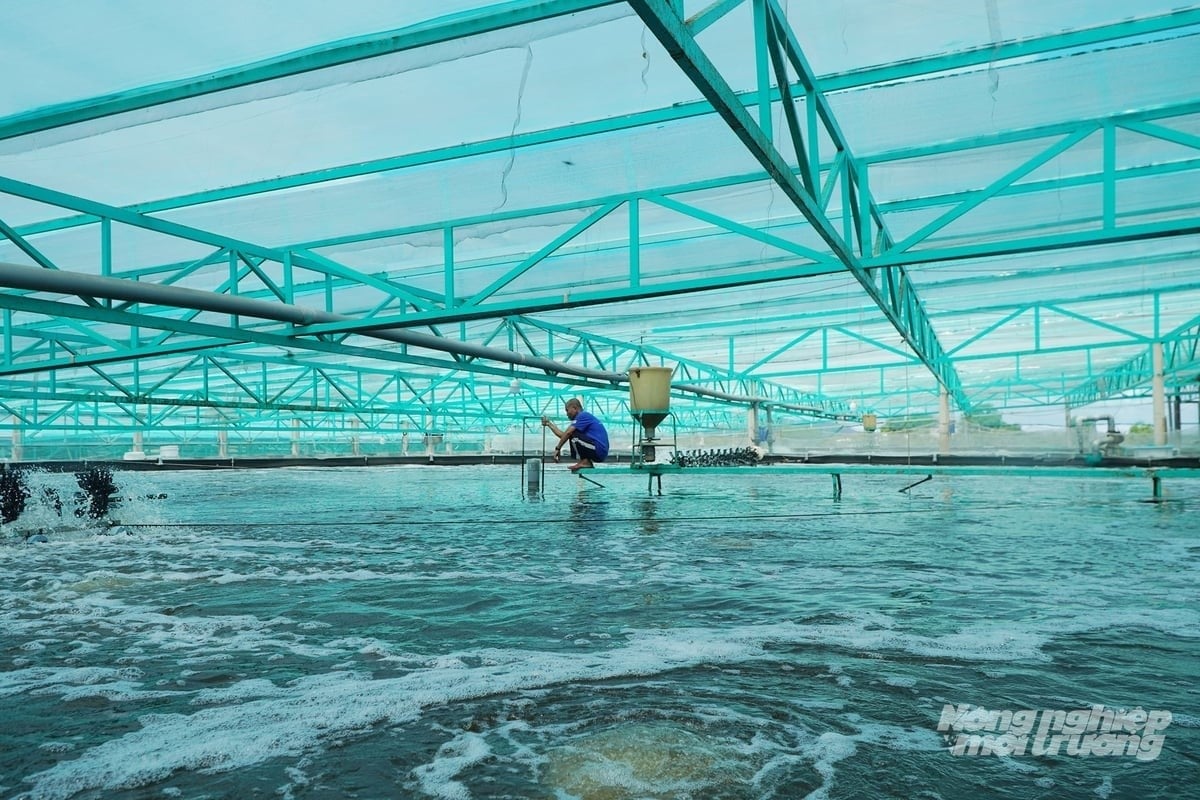
Many enterprises and cooperatives have been making strong investments in high-tech shrimp farming, such as Quyet Thang Agricultural Cooperative in Ho Chi Minh City. Photo: Nguyen Thuy.
“Shrimp farming is essentially about managing water, but for nearly 30 years, the irrigation system in the Mekong Delta has primarily served rice production. In many areas, the canals are used for both water supply and drainage. When a disease-affected pond discharges water, another pond may take in that same water,” Mr. Hoang explained.
VAS proposed that the MAE develop a comprehensive investment program for separate water supply and drainage systems in shrimp farming areas, while also expanding three-phase power infrastructure to serve high-tech shrimp farming.
In particular, greater investment is needed in research on diseases, nutrition, and the genetic resources of broodstock shrimp to ensure a proactive domestic supply of shrimp seed. At the same time, businesses should be required to ensure transparency regarding the origin of raw shrimp used for processing to protect Viet Nam’s shrimp industry.
According to Mr. Hoang, on June 8, 2026, the U.S. Congress introduced the SHRIMP Act 2026, which calls for developing scientific methods to determine the country of origin of shrimp to control trade fraud, combat IUU fishing, and strengthen traceability.
Against this backdrop, Viet Nam needs to promptly establish a comprehensive mechanism to monitor and ensure transparency regarding the origin of imported shrimp used for processing, in order to protect the reputation of the shrimp industry and the interests of millions of domestic shrimp farming households.
The Chairman of VAS also expressed concern over obstacles to the development of shrimp seed production areas. According to him, the area stretching from the former Binh Thuan province to Lam Dong, particularly the coastal strip from Ca Na to Vinh Hao, is home to the country’s highest-quality shrimp seed production. However, many businesses have yet to have their land leases renewed after their 20-year terms expire, preventing them from continuing to invest in production.
The association proposed that the MAE coordinate with local authorities to promptly resolve planning-related obstacles, creating favorable conditions for enterprises to invest in research, develop shrimp broodstock genetic resources, and establish high-quality shrimp seed production centers.
“VAS will continue to accompany the Government, enterprises, and farmers to develop the shrimp industry in a green, modern, efficient, and sustainable direction, with the goal of making Viet Nam one of the world’s leading shrimp production and export hubs,” Chairman of VAS Mai Van Hoang affirmed.
Agriculture News | Agri Products Price