


(VAN) According to the General Director of Minh Phu Seafood Corporation, developing disease-resistant shrimp varieties, coupled with appropriate policies, would help strengthen the competitiveness of Viet Nam’s shrimp industry.
To maintain the position and enhance the competitiveness of Vietnamese seafood in the global market, the shrimp industry needs a breakthrough in support policies, breeding strategies, and capitalization on its advantages in the deep-processing segment.
The remarks were made by Mr. Le Van Quang, General Director of Minh Phu Seafood Corporation, at a conference with industry associations on promoting agricultural, forestry, and fishery exports in the second half of 2026. The conference was organized by the MAE on July 30.

Mr. Le Van Quang, General Director of Minh Phu Seafood Corporation. Photo: Khuong Trung.
According to Mr. Le Van Quang, amid increasingly intense global competition, Viet Nam needs to promptly launch a program to breed disease-resistant shrimp varieties that are well adapted to local farming conditions, following Ecuador’s successful model.
The General Director of Minh Phu Seafood Corporation pointed out that, thanks to more than a decade of consistently applying disease-resistant shrimp varieties, Ecuador’s shrimp industry has experienced virtually no major disease outbreaks and has maintained double-digit growth rates. This has been a key factor enabling this country to achieve the world’s lowest shrimp farming costs while maintaining very high productivity.
In addition to addressing the problem of seed technology, Minh Phu’s leader proposed that the MAE, together with relevant ministries and agencies, continue to work closely with businesses and conduct research to improve regulations on product standards; environmental requirements; fire prevention and firefighting; as well as personal income tax and social insurance policies, in line with those of regional countries such as Thailand and Singapore. This would help create a fair competitive environment for businesses.
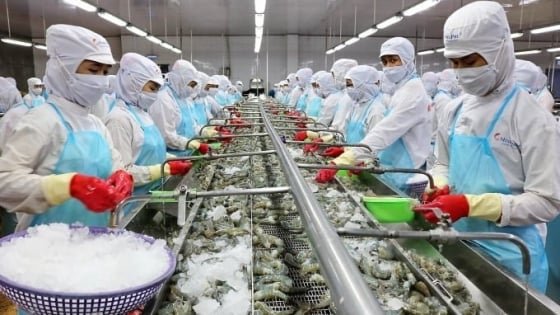
In particular, the representative of Minh Phu candidly identified the most significant bottleneck facing seafood enterprises, especially those in the Mekong Delta, as a severe shortage of unskilled labor.
“This is an issue that businesses themselves find very difficult to resolve. We urgently need attention from the Ministry and the Government, along with appropriate solutions to help businesses overcome this difficulty,” Mr. Quang said. He added that Minh Phu has secured a record volume of orders, exceeding its existing production capacity, and is urgently recruiting workers to increase its order-fulfillment capacity. However, the number of workers recruited so far has yet to meet actual demand.
Analyzing the market outlook for 2026, General Director of Minh Phu said the shrimp industry was being heavily affected by global economic fluctuations. The economic downturn has prompted consumers worldwide to tighten their spending and shift to shrimp one to two sizes smaller, causing average processing output to decline by around 20%.
Notably, while rising oil prices have pushed up the prices of wild-caught seafood and other food products such as pork, chicken, and beef by around 20–50%, shrimp prices have not increased and have even declined. Ecuador and India, the world’s two largest producers of raw shrimp, have been selling at their lowest prices in more than 20 years.
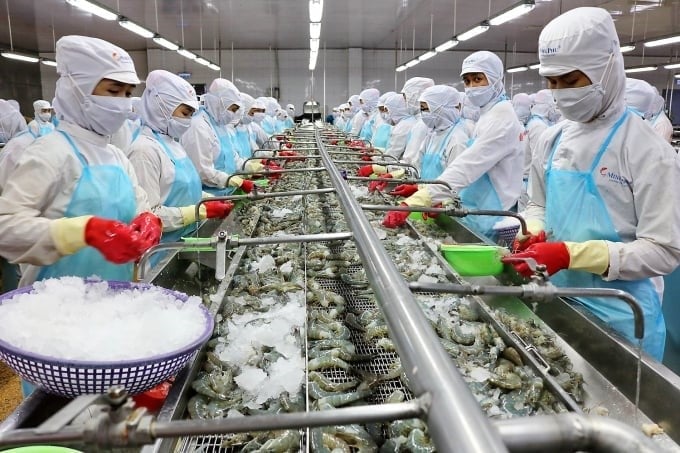
Seafood enterprises, particularly those in the Mekong Delta, are currently facing a severe shortage of unskilled labor. Photo: VAN.
“This has inadvertently stimulated demand for shrimp, as shrimp prices are currently relatively low compared with many other food products,” Mr. Quang said. He added that Viet Nam mainly focuses on producing processed shrimp products with added value, while Ecuador and India specialize in exporting raw shrimp. As a result, Vietnamese products face less direct competition from these two countries.
“By focusing on value-added products, Viet Nam can command good prices while maintaining high consumption volumes,” the General Director of Minh Quang emphasized.
Regarding business performance in the first six months of the year, Mr. Quang said the group had recorded positive signs. In the first half of 2026, output reached 24,808 tons, up 13.92% from the same period in 2025, while export turnover reached USD 265.454 million, up 10.37%. These results represented 36.5% of the annual output target and 36.25% of the annual export turnover target.
“The right strategic direction, together with the operation of the Minh Phu Khanh An Factory, helped expand production capacity in the first half of 2026,” said General Director of Minh Phu Seafood Corporation Le Van Quang.
According to the Viet Nam Shrimp Association (VSA), in the first six months of 2026, shrimp exports reached approximately USD 2.3 billion, up 13.6% from the same period in 2025 and accounting for 40.5% of Viet Nam’s total seafood export turnover.
Agriculture News | Agri Products Price